Israel’s Mission in the World

Divine Violence and the Character of God

In my book, Divine Violence and the Character of God (Eugene, OR: Wipf & Stock, 2022), I discuss Israel’s mission in the world. Here is a summary of how Israel’s mission takes shape through the arguments in my book:

1. Witnesses to the Divine Pathos

Rather than portraying Israel’s mission as simply surviving or enacting judgment, my book emphasizes that Israel is called to understand and reflect the pathos of God. Because God is not detached but deeply affected by human suffering and sin, Israel’s mission involves entering into that same emotional and spiritual alignment. They are to see divine judgment not as detached cruelty, but as the reluctant, painful recourse of a suffering Creator who judges in order to heal.

2. A Mission of Ethical Distinctiveness (The Justice of God)

By contextualizing violent biblical narratives within ancient Near Eastern frameworks, I demonstrate that Israel was given a unique, counter-cultural identity. Israel’s mission in the world was to live out a standard of justice that resisted the oppressive, unchecked violence of neighboring empires. Any divine violence enacted in the narrative is framed as a defense of the oppressed and an undoing of systemic evil, meaning Israel’s true calling was to embody a society free from the socio-economic exploitation that plagued the ancient world.

3. Precursors to Ultimate Reconciliation

A central pillar of my argument is bridging the perceived gap between the “Warrior God” of the Old Testament and the “Christ of the Cross” in the New Testament. In this light, Israel’s historical journey—even through its dark chapters of conflict and exile—serves a grander, missional purpose: preparing the way for global reconciliation. Israel’s mission was to carry the story of a God who battles chaos and sin, ultimately culminating not in the destruction of humanity, but in the self-giving love of the cross.

In short, I frame Israel’s mission as being the historical vehicle through which the world learns that God’s justice is always in service of His grace, and His ultimate goal is always restoration.

CHECK OUT MY NEW BOOK. Click here: Praying the Psalms: Finding Your Voice in Israel’s Prayer Book.

Claude Mariottini
Emeritus Professor of Old Testament
Northern Baptist Seminary

If you enjoyed reading this post, you will enjoy reading my books.

VISIT MY AMAZON AUTHOR’S PAGE

BUY MY BOOKS ON AMAZON (Click here).

NOTE: Did you like this post? Do you think other people would like to read this post? Be sure to share this post on Facebook and share a link on X so that others may enjoy reading it too!

If you are looking for other series of studies on the Old Testament, visit the Archive section and you will find many studies that deal with a variety of Old Testament topics.

The Fountain of Life (Psalm 36)

“For with you is the fountain of life; in your light we see light” (Psalm 36:9).

In the middle of Psalm 36, nestled between David’s observations about human wickedness and his plea for God’s continued protection, we encounter one of Scripture’s most luminous declarations: “For with you is the fountain of life; in your light we see light.” This verse does not merely describe God’s attributes; it reveals the fundamental nature of our existence and the source from which all meaning flows.

The image of a fountain is striking in its vitality. Unlike a cistern that holds stagnant water, a fountain bubbles up continuously, fresh and life-giving. In the ancient Near East, where water determined survival, a reliable fountain meant the difference between flourishing and perishing. David understood this reality intimately from his years in the wilderness, and he applies it to spiritual truth: God himself is not merely a source of life but the fountain from which all life springs. Everything that truly lives does so because it draws from him.

This is not abstract theology; it is the daily reality of our existence. We wake each morning sustained by a heartbeat we did not initiate, breathing air we did not create, animated by a consciousness we cannot fully explain. Every moment of genuine joy, every experience of authentic love, every instance of beauty that catches our breath, these are drops of water from the eternal fountain. We live and move and have our being in him, whether we acknowledge it or not.

But David does not stop with the fountain image. He adds another metaphor that deepens our understanding: “in your light we see light.” This second phrase unlocks something profound about how we perceive reality itself. Light not only allows us to see, but it also transforms what we see. The same room looks entirely different in candlelight, fluorescent glare, or golden sunrise. Similarly, God’s light does not just illuminate objects; it changes how we understand everything.

Consider how many people search for meaning in achievement, relationships, possessions, or experiences, only to find these things strangely hollow when obtained. Why? Because they are examining life by the wrong light. Apart from God’s illumination, we fundamentally misunderstand what we are looking at. We mistake shadows for substance, temporary pleasures for lasting joy, and self-assertion for true strength. We are like people trying to appreciate a masterpiece painting in a darkened gallery, fumbling to make sense of shapes we can barely perceive.

In God’s light, everything becomes clear. Suffering reveals its capacity to refine rather than merely destroy. Humility appears as strength rather than weakness. Service to others becomes freedom rather than bondage. Death itself, that darkest of all human realities, transforms into a doorway rather than a wall. None of these truths is visible by the dim lights of human wisdom alone; they require divine illumination.

This explains why Scripture speaks so often about spiritual blindness. It is not that unbelievers lack intelligence or perception, but that they are operating with inadequate light. Paul describes people whose “foolish hearts were darkened,” and Jesus speaks of those who “seeing do not see.” The tragedy is not a lack of information but a lack of illumination, the inability to perceive what the available information actually means.

For believers, this verse offers both comfort and challenge. The comfort is knowing that we do not have to generate our own life or manufacture our own understanding. We can come to the fountain daily, confident that it will never run dry. We can ask for light, trusting that God delights in revealing truth to those who seek him. The spiritual life is not about achieving but receiving, not about climbing to God but opening ourselves to what he freely offers.

The challenge, however, is equally clear: Are we actually drinking from the fountain, or are we trying to survive on what our own efforts can produce? Are we truly seeing by God’s light, or are we still squinting in the darkness of cultural assumptions, personal preferences, and comfortable illusions? The fountain is available, the light is shining, but we must choose to approach and allow our eyes to adjust to truths that may initially seem strange or difficult.

Today, you stand at a choice point. Will you return to the fountain? Will you ask for eyes to see by divine light rather than human wisdom? The invitation stands open, as fresh this morning as it was when David first penned these words three thousand years ago.

PRAYER

Father, you are the fountain of life, and apart from you, we have nothing that lasts. Forgive us for the countless times we have sought satisfaction in broken cisterns of our own making. Today, we come to you thirsty. Illuminate our minds with your truth, that in your light we might see everything: our joys and sorrows, our relationships and responsibilities, our past and our future, as they truly are. Give us eyes to see and hearts to receive. Amen.

NOTE

This post is a section of my new book: Praying the Psalms: Finding Your Voice in Israel’s Prayer Book.

Praying the Psalms contains a devotional on all 150 psalms. If you enjoyed this post, you will enjoy the other 149 devotionals in the book.

You can order the book from Ancient Path Press.

Claude Mariottini
Emeritus Professor of Old Testament
Northern Baptist Seminary

If you enjoyed reading this post, you will enjoy reading my books.

VISIT MY AMAZON AUTHOR’S PAGE

BUY MY BOOKS ON AMAZON (Click here).

NOTE: Did you like this post? Do you think other people would like to read this post? Be sure to share this post on Facebook and share a link on X so that others may enjoy reading it too!

If you are looking for other series of studies on the Old Testament, visit the Archive section and you will find many studies that deal with a variety of Old Testament topics.

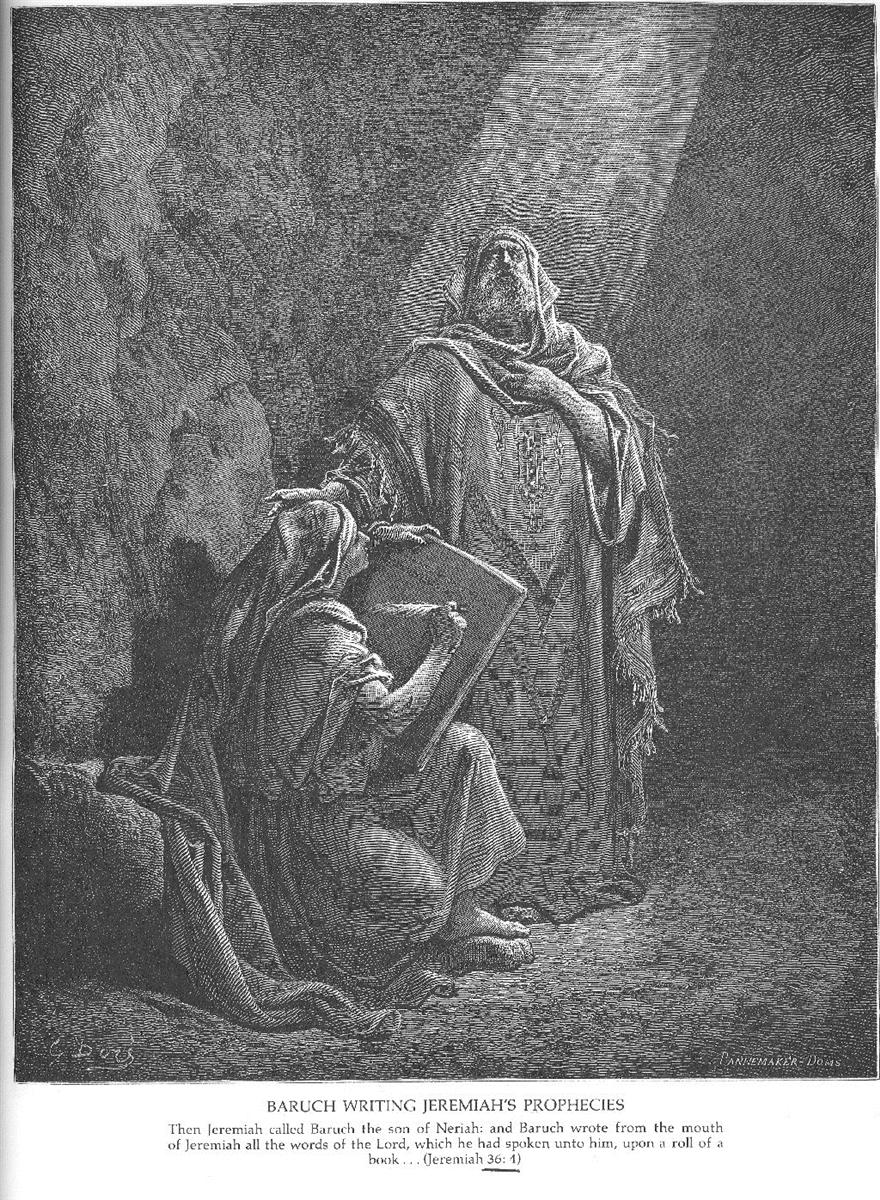
Baruch ben Neriah (Jeremiah 45)

Paul Gustave Doré
(b: January 6, 1832; d. January 23, 1883)


The Text

“The word that the prophet Jeremiah spoke to Baruch son of Neriah, when he wrote these words in a scroll at the dictation of Jeremiah, in the fourth year of King Jehoiakim son of Josiah of Judah: Thus says the LORD, the God of Israel, to you, O Baruch: You said, ‘Woe is me! The LORD has added sorrow to my pain; I am weary with my groaning, and I find no rest.’ Thus you shall say to him, ‘Thus says the LORD: I am going to break down what I have built, and pluck up what I have planted– that is, the whole land. And you, do you seek great things for yourself? Do not seek them; for I am going to bring disaster upon all flesh, says the LORD; but I will give you your life as a prize of war in every place to which you may go’” (Jeremiah 45:1–5 NRSV).

Introduction

The book of Jeremiah is dominated by oracles of doom and destruction, reflecting the catastrophic political and spiritual collapse of Judah in the late seventh and early sixth centuries BCE. Against this backdrop, the forty-fifth chapter functions as a striking anomaly: a brief, highly personal oracle addressed not to the nation but to a single individual: Baruch ben Neriah, Jeremiah’s scribe. The chapter encapsulates both a word of lament from Baruch and a divine response mediated through Jeremiah, culminating in a promise of personal preservation set against a wider horizon of divine judgment.

The brevity and apparent singularity of Jeremiah 45 have prompted considerable scholarly discussion regarding its literary function and placement. Questions of authorship, historical occasion, and theological purpose intersect in ways that resist easy resolution. Nevertheless, when read within the cumulative narrative of Jeremiah 36–44, the chapter yields significant insights into the nature of prophetic discipleship, divine pathos, and the covenant relationship between Yahweh and Israel. This study of Jeremiah 45 proceeds by first examining Baruch’s identity and role, and by exploring its theological implications at both the individual and communal levels.

The Identity and Role of Baruch ben Neriah

Baruch is introduced in the text as the son of Neriah (or, in some textual traditions, Seraiah), serving as Jeremiah’s professional scribe. His scribal function is established explicitly in Jeremiah 36:4–8, where he is charged with reading aloud the scroll of prophetic oracles in the Temple precincts. Beyond his secretarial role, Baruch functioned as Jeremiah’s disciple and companion, accompanying the prophet into Egypt following the assassination of Gedaliah. Given the scope of this sustained collaboration, it is probable that Baruch participated directly in the events narrated in Jeremiah 34–44 and bore responsibility for documenting Jeremiah’s prophetic activity from the earliest stage of his ministry.

Scribes in the ancient Near East typically emerged from families of established social standing, and their professional trajectory offered genuine possibilities for advancement within administrative and cultic institutions. Baruch’s lament in chapter 45 reflects, in part, a sense of professional and personal failure, a recognition that the aspirations appropriate to his class and training had been foreclosed by historical circumstance. Without the anchoring institutions of land and Temple, which together constituted the socioeconomic and religious foundations of Judahite society, Baruch found himself adrift, his ambitions, perhaps oriented toward a promising career in Egypt, rendered unrealizable. The divine reprimand in verse five, wherein Yahweh questions Baruch’s pursuit of “great things,” may be read as a critique of aspirations more self-directed than consonant with the purposes of the Kingdom.

Notably, Jeremiah 45 represents the sole occasion within the Hebrew Bible on which Baruch’s own voice is heard. Prior to this chapter, he appears exclusively as a functional agent in the narrative, a recorder and reader of prophetic words. His emergence as a speaking subject, giving voice to suffering and pain rather than proclamation or hope, renders the chapter all the more remarkable as a window into the interior life of a figure who had otherwise remained at the narrative periphery.

Baruch’s Lament and its Historical Context

The theological significance of Baruch’s lament must be understood against the backdrop of the cumulative catastrophe narrated in Jeremiah 36–44. The fall of Jerusalem to Babylonian forces constitutes the thematic center of this section, and Baruch, as both witness and chronicler, could not have remained untouched by the events he recorded. The prophetic words of judgment he had transcribed, the exile he had observed, and the devastation of the community he belonged to together constitute the experiential horizon from which his grief emerges. The collapse of the religious and political institutions foundational to Israelite identity rendered hope and joy scarce commodities.

Significantly, the sorrow articulated by Baruch resonates with expressions of grief found elsewhere in the Jeremianic corpus—on the lips of both Jeremiah himself (8:18; 20:18) and Yahweh (8:18; 4:19). This convergence of lament creates a bond of shared suffering linking Baruch, the prophet, and the divine. It is precisely out of this shared pain that Baruch can be understood as intimately participating in Jeremiah’s mission and bound together with him within the purposes of Yahweh.

Divine Pathos and the Response of Yahweh

A superficial reading of Yahweh’s response to Baruch’s lament might characterize it as curt and emotionally disengaged, a bare promise of physical survival that offers little pastoral comfort. However, a more careful reading of verse five reveals a profound dimension of divine pathos. Yahweh’s declaration that he is tearing down what he has built and uprooting what he has planted is not the language of indifference but of grief. The destruction of Israel represents, from the perspective of the divine narrator, a devastating personal loss: Yahweh’s most cherished intentions for the covenant people have again been frustrated, necessitating the dismantling of what had been so carefully constructed.

The pain embedded in Yahweh’s message to Baruch reflects the broader Jeremianic theology of divine suffering, in which Yahweh is not an impassive judge but a deeply invested covenant partner whose grief at Israel’s unfaithfulness permeates the prophetic tradition. The oracle thus invites Baruch, and the reader, to understand personal suffering as participating in a larger drama of divine loss, and to recognize that the promise of survival extended to Baruch, though modest in its scope, is nonetheless an expression of Yahweh’s continuing covenantal fidelity.

Baruch as Symbolic Figure

The interplay between individual and communal dimensions of the oracle is especially evident in verse five. While the oracle is addressed to Baruch as a person, its implications extend beyond him to the wider community of Israel. Baruch’s situation, accompanying Jeremiah into Egyptian exile not by choice but by force, sharing in the communal displacement while maintaining personal faithfulness, positions him as a representative figure. Baruch becomes a type of “the wandering Jew”: the Israelite carried into the diaspora against his will, forced to share the consequences of a communal failure he did not precipitate.

The extension of the personal oracle to wider communal application is reinforced by Jeremiah 51:59–64, which revisits the figure of Seraiah (likely related to Baruch’s family) in a context of symbolic prophetic action directed toward the Babylonian exile. The individual word to Baruch thus opens onto a broader horizon of divine promise and communal restoration glimpsed in passages such as Jeremiah 31:13 and 30:15. The personal is not isolated from the covenantal; rather, the oracle to Baruch functions as a microcosm of Yahweh’s ongoing relationship with Israel.

The chapter also hints at a tension between Baruch’s individual ambitions and his vocational calling. The consolatory nature of Jeremiah’s words to his disciple and companion stands alongside a gentle reproof of aspirations perhaps insufficiently oriented toward the divine purposes. In this sense, Baruch embodies the perennial tension within prophetic discipleship between personal aspiration and covenantal obedience. That he ultimately persevered in faithfulness to both Jeremiah and Yahweh renders him a paradigmatic figure of endurance, one who accepted the limits imposed by his historical moment without abandoning his vocation.

Conclusion

Jeremiah 45, despite its brevity, constitutes a theologically significant unit within the book of Jeremiah. The chapter illuminates the inner life of Baruch ben Neriah, the sole occasion on which his voice is heard in the Bible, and situates his personal lament within the wider context of Judah’s catastrophic encounter with divine judgment. The oracle he receives, though austere in its promise of mere survival, participates in the larger Jeremianic theology of divine pathos and covenantal faithfulness.

The theological purpose of the chapter may be understood as covenantal in the deepest sense: Yahweh has heard the lament of his servant, responded with honesty about the gravity of the historical moment, and preserved the life of one who remained faithful amid the ruins of a collapsed world. In this, Baruch’s story becomes not merely a historical footnote but a testament to the enduring character of divine fidelity, a promise of life spoken into the heart of desolation.

CHECK OUT MY NEW BOOK. Click here: Praying the Psalms: Finding Your Voice in Israel’s Prayer Book.

Claude Mariottini
Emeritus Professor of Old Testament
Northern Baptist Seminary

If you enjoyed reading this post, you will enjoy reading my books.

VISIT MY AMAZON AUTHOR’S PAGE

BUY MY BOOKS ON AMAZON (Click here).

NOTE: Did you like this post? Do you think other people would like to read this post? Be sure to share this post on Facebook and share a link on X so that others may enjoy reading it too!

If you are looking for other series of studies on the Old Testament, visit the Archive section and you will find many studies that deal with a variety of Old Testament topics.

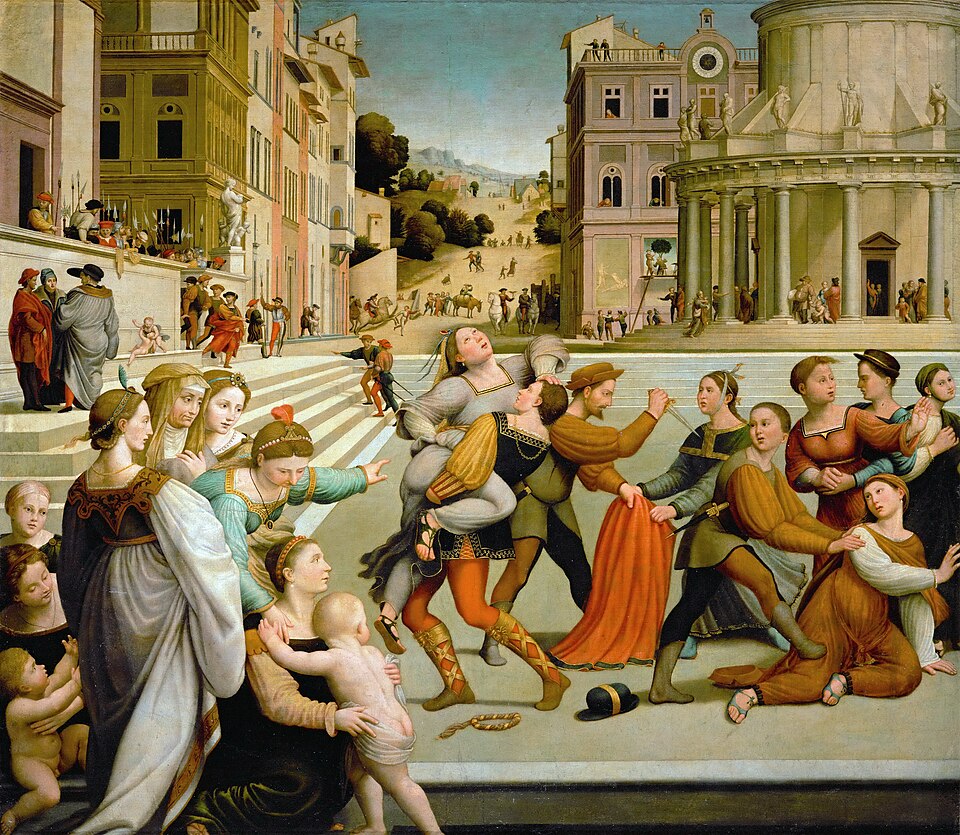
The Rape of Dinah

Rape of Dinah
By Giuliano Bugiardini (b. 1475)
Public Domain, Wikipedia Commons

The Text

“Now Dinah the daughter of Leah, whom she had borne to Jacob, went out to visit the women of the region. 2 When Shechem son of Hamor the Hivite, prince of the region, saw her, he seized her and lay with her by force. 3 And his soul was drawn to Dinah daughter of Jacob; he loved the girl, and spoke tenderly to her. 4 So Shechem spoke to his father Hamor, saying, ‘Get me this girl to be my wife.’” (Genesis 34:1–4 NRSV).

Dinah Goes Out

Dinah’s story opens with a deceptively simple statement: “Now Dinah the daughter of Leah, whom she had borne to Jacob, went out to visit the women of the region” (Gen 34:1). This single verse has generated considerable interpretive controversy because Dinah’s act of going out has sometimes been read as reckless, immodest, or even morally culpable. One Jewish commentator said that her going out was evidence of immodesty, as though her movement through public space implicitly invited the violence that followed.

Such interpretations, however, reflect the anxieties of a patriarchal culture far more than they illuminate the text itself. The Hebrew verb “to go out” is a perfectly ordinary word for movement and carries no intrinsic moral connotation. The phrase “to visit” or “to see” the women of the land describes nothing more than a young woman seeking social connection with her female contemporaries. Jacob’s family had recently settled near the city of Shechem (Gen 33:18–20), and Dinah, living in a newly established household in an unfamiliar territory, would have had every natural reason to seek out the company of other women. Her action was not reckless; it was simply human.

What the text reveals in this opening verse, however, is more than Dinah’s own motivation. It reveals the vulnerability that attended ordinary female life in the ancient world. Women in ancient Israel moved through social space under constant risk, not because of any inherent moral deficiency on their part, but because of the social and legal structures of a patriarchal society in which a woman’s body was, in practice, the property of her father until it became the property of her husband. Dinah’s going out was not an act of rebellion or immorality. It was simply an ordinary act of sociality that exposed her to an extraordinary act of violence.

Dinah’s Encounter with Shechem

Genesis 34:2 records the encounter between Shechem and Dinah in stark and disturbing language: “When Shechem son of Hamor the Hivite, prince of the region, saw her, he seized her and lay with her by force.” The Hebrew of this verse employs three verbs in rapid succession—“he took”; “he lay with”; and “he humiliated” or “he violated.” These words together constitute the Hebrew idiom for sexual assault. The Hebrew verb translated “humiliated” carries the clear sense of coercive violation. The emphasis that the humiliation was done “by force” makes the coercive nature of the act explicit: it was rape.

Some scholars have attempted to soften the reading of Genesis 34:2 by arguing that the subsequent verses, which describe Shechem’s love and desire for Dinah, complicate any simple reading of the event as rape. Verse 3 states that “his soul was drawn to Dinah daughter of Jacob; he loved the girl and spoke tenderly to her.” The phrase “spoke tenderly to her” (literally, “spoke upon her heart”) is sometimes cited as evidence of a more complex emotional reality. However, the appearance of affection after the fact does not retroactively transform a coercive act into a consensual one. The narrative sequence is unambiguous: seizure and violation precede any expression of affection. The love described in verse 3 is the love of a man who has already taken what he wanted; it is desire expressed after the fact, not a relationship established by mutual consent.

The text, therefore, does not leave genuine ambiguity about the nature of the initial encounter. What it does leave ambiguous, and what is equally important for understanding Dinah’s situation, is everything that follows. After the assault, Dinah remains in Shechem’s house. She does not flee. She does not appear again until verse 26, when Simeon and Levi take her out. The text offers no explanation for her continued presence, and this silence is itself theologically and socially significant

Dinah in Shechem’s House

One of the most significant features of Genesis 34 is that Dinah is never brought home after the assault. She remains in Shechem’s house throughout the entire negotiation between the men of the two families. Jacob learns of the violation and “held his peace” until his sons returned from the field (v. 5). The brothers come home, are furious, and begin a negotiation with Hamor and Shechem about the terms under which the matter might be settled (vv. 6–17). Nowhere in this negotiation does anyone ask Dinah what she wants. Nowhere does anyone go to bring her home before the terms are settled.

Why did Dinah remain in Shechem’s house? The text does not say. Three possibilities present themselves, and the deliberate silence of the narrator refuses to privilege any one of them definitively.

First, it is possible that Dinah was held against her will, effectively a prisoner in Shechem’s house, and that her continued residence there was an extension of the coercion that began with the assault itself. Second, it is possible that, having been violated, Dinah had nowhere safe to go—that returning to her father’s house as a woman who had lost her virginity outside of marriage would have exposed her to social consequences scarcely less devastating than her current situation. Third, and most uncomfortably for modern readers, it is possible that Shechem’s subsequent tenderness had created some form of emotional bond, however complex and compromised its origins.

The text, by its silence, denies us the comfort of a clean answer. And this denial is itself a form of honesty about the reality of women’s lives in the ancient world. Dinah’s inner life is inaccessible not because the narrator forgot to include it, but because in the world the narrative reflects, Dinah’s inner life was socially irrelevant. What mattered was not what Dinah thought or felt or wanted, but what the men around her decided to do. Her silence in the text is not an accidental omission; it is a faithful representation of her social invisibility in the world of ancient Israel.

Shechem’s Desire for Marriage

Shechem’s desire to marry Dinah is presented in the text with some degree of sincerity. Verse 3 describes his love for her, and verse 4 records that he asked his father Hamor to arrange the marriage: “Get me this girl to be my wife.” Verse 8 reiterates Hamor’s report to Jacob and his sons that “My son Shechem longs for your daughter; please give her to him in marriage.”

Shechem himself, in verse 11, addresses Jacob and the brothers directly: “Let me find favor with you, and whatever you say to me I will give. Put the marriage present and gift as high as you like, and I will give whatever you ask me; only give me the girl to be my wife.”

On the surface, this desire for marriage might appear to mitigate the severity of what Shechem had done. In the ancient Near Eastern legal context, a man who had violated an unbetrothed virgin was required to pay the bride price and marry her.

The ancient legal framework that required marriage after rape was not designed to protect the victim; it was designed to protect the economic interests of her father, whose property (the bride’s virginity) had been damaged without compensation. Shechem’s desire to marry Dinah does not erase or even substantially address the fact that his initial act was coercive. Marriage to one’s rapist, however normalized in the ancient world, is not justice for the rape victim.

His appeal to Hamor is not “Consult Dinah and ask whether she wishes to marry me” but rather “Get me this girl.” She is the object of desire, not a subject with whom desire is to be negotiated. His tenderness toward her may be genuine within the framework of his cultural world, but it is a tenderness that does not recognize her as an agent with the right to accept or refuse.

The Dishonorable Actions of the Brothers

Simeon and Levi’s response to the violation of their sister has often been described as an act of righteous vengeance, and there is a sense in which it is motivated by genuine anger at a genuine wrong. But a careful reading of the text reveals that their actions are, in important respects, dishonorable in their own right, and that their conception of justice is one in which Dinah’s own interests are entirely secondary to their wounded pride.

The brothers’ stratagem is deceptive. They agree to the circumcision requirement in bad faith, “because he had defiled their sister Dinah” (v. 13), with the explicit intent to use the period of convalescence to carry out a massacre (v. 25). Jacob’s rebuke of Simeon and Levi in verse 30 focuses entirely on the practical political dangers their actions have created: “You have brought trouble on me by making me odious to the inhabitants of the land.” In the final exchange of the chapter, the brothers justify their actions with the rhetorical question: “Should our sister be treated like a prostitute?” (v. 31). This closing question is the only moment in the entire chapter in which Dinah is treated as a person with dignity worth defending, but even here, the indignation is framed in terms of the brothers’ honor, not Dinah’s person.

Moreover, the massacre of the Shechemites, however morally comprehensible as an act of rage at the violation of a family member, kills every man in the city (v. 25), including those who bore no personal responsibility for Shechem’s act. The subsequent plundering of the city (vv. 27–29), which involves the taking of “their flocks and their herds and their donkeys” and the capture of “their little ones and their wives,” is explicitly noted as an act of all the brothers, not merely Simeon and Levi.

The women of Shechem—who, like Dinah, had no agency in the events that led to the massacre—are themselves now reduced to war captives. The cycle of violence that began with Shechem’s violation of Dinah ends with the brothers committing their own acts of violence against women who had no voice or power in the matter.

Most tellingly, the brothers’ actions never consult Dinah. There is no moment in the narrative where Simeon or Levi asks Dinah whether she wishes to be “rescued” from Shechem’s house, whether she wished to marry Shechem, or what kind of resolution she herself desired. When Simeon and Levi “took Dinah out of Shechem’s house and went away” (v. 26), the language is identical to the possessive seizure that characterized Shechem’s initial act: she is taken, not consulted. One violation is answered with another form of taking, and the woman at the center of it all is moved from location to location by the decisions of men, without ever being granted the dignity of a voice.

Conclusion: Honor, Shame, and the Economics of the Female Body

The entire social logic of Genesis 34 is related to the ancient concept of honor and shame system. In this system, honor was a public, social reality that attached to families and to male household heads, and shame was the consequence of acts that violated the community’s expectations of proper social behavior. A woman’s sexual purity was not conceived primarily as her own personal asset; it was a component of her family’s honor, managed by the male household head and transferred intact to a husband upon marriage.
When Shechem violated Dinah, the harm that the text registers most explicitly is not the harm to Dinah but the harm to the brothers’ sense of honor. Verse 7 states that the brothers were “indignant and very angry, because he had committed an outrage in Israel by lying with Jacob’s daughter, for such a thing ought not to be done.”

The brothers’ anger is real, and their sense of violation is understandable within their cultural framework. But their framing of the event is telling: Shechem “made their sister a prostitute” (v. 31, literally “treated our sister as a prostitute”), language that places the shame squarely on Dinah’s compromised social status rather than on her suffering as a person.

The negotiations between Hamor and the brothers proceed entirely on the terrain of economic and social exchange. Hamor proposes intermarriage between the two peoples and mutual sharing of the land (vv. 9–10). Shechem offers an unlimited bride price (vv. 11–12). The brothers counter with the demand for circumcision (vv. 14–17). Nowhere in this extended negotiation does Dinah’s welfare, her desires, or her emotional state appear as a consideration. She is the occasion for the negotiation, not a participant in it. She has been reduced, in the logic of the honor-shame economy, to a unit of social currency.

NOTE: The story of Dinah is one of the many story of abused women in the Old Testament. For other stories of abused women in the Old Testament, read my book, Ancient Israel’s Women of Faith: A Survey of the Heroines of the Old Testament.

CHECK OUT MY NEW BOOK. Click here: Praying the Psalms: Finding Your Voice in Israel’s Prayer Book.

Claude Mariottini
Emeritus Professor of Old Testament
Northern Baptist Seminary

If you enjoyed reading this post, you will enjoy reading my books.

VISIT MY AMAZON AUTHOR’S PAGE

BUY MY BOOKS ON AMAZON (Click here).

NOTE: Did you like this post? Do you think other people would like to read this post? Be sure to share this post on Facebook and share a link on X so that others may enjoy reading it too!

If you are looking for other series of studies on the Old Testament, visit the Archive section and you will find many studies that deal with a variety of Old Testament topics.

THE SOUL’S DEEP LONGING (Psalm 84)

“My soul yearns, even faints, for the courts of the LORD; my heart and my flesh cry out for the living God” (Psalm 84:2).

There is a hunger built into the human heart that nothing earthly can satisfy. The psalmist captures this profound truth with visceral language that speaks to our deepest experience. He does not merely say he wants to go to the temple or that he thinks worship is important. He uses words like “yearns,” “faints,” and “cry out,” the vocabulary of desperate need, not casual preference.

This verse reveals three dimensions of spiritual longing that resonate across the centuries to our own souls today.

First, notice the intensity of the desire. The soul does not just want or wish; it yearns. This is the language of aching, of being stretched toward something just beyond reach. The Hebrew word suggests a longing so intense it causes physical weakness, even to the point of fainting. Have you ever wanted something so badly that it left you breathless? This is how the psalmist describes his longing for God’s presence.

We live in an age of casual spirituality, where faith is often reduced to a lifestyle accessory or a source of occasional inspiration. But the psalmist reminds us that a true relationship with God engages us at the deepest level. It is not about fitting God into our schedule or adding religious practices to our routine. It is about recognizing that our souls were made for him and cannot rest until they rest in him.

Second, observe the completeness of the longing. The psalmist says both his heart and his flesh cry out. This is not merely intellectual assent or emotional sentiment; it is a whole-person response. Our minds may engage theological concepts, our emotions may respond to worship, but there is something more profound happening here. The “flesh” crying out suggests that even our physical bodies are attuned to this spiritual reality. We are integrated beings, and our longing for God involves every part of who we are.

This challenges the false division between the spiritual and physical aspects of life. The psalmist does not apologize for the bodily dimension of worship or try to spiritualize it away. Instead, he embraces it. When we gather for worship, when we lift our hands, when we kneel in prayer, when we fast or feast in celebration, these physical acts matter because we are embodied souls. Our whole selves were designed to connect with our creator.

Third, consider the object of this longing: “the living God.” Not an idea, not a philosophy, not even a set of religious practices, but a living, personal God. The psalmist yearns for the courts of the Lord because that is where God’s presence dwells. The temple, the tabernacle, the gathered assembly, these were not ends in themselves but gateways to encountering the One who is alive and active.

This phrase “the living God” distinguished Israel’s faith from the surrounding cultures with their lifeless idols. Those gods of wood and stone could neither hear nor respond. But the God of Israel is dynamic, personal, and present. He sees, hears, acts, and relates. This is why the psalmist’s longing makes sense: you can have a relationship with a living God in ways that are impossible with mere religious concepts.

For us today, this verse poses a challenging question: do we share this intensity of longing? In our world of endless entertainment and comfortable religion, have we lost touch with this deep hunger? Or have we perhaps tried to satisfy it with substitutes, with religious activity instead of relationship, with theological knowledge instead of transformative encounter, with the trappings of faith instead of the living God himself?

The beautiful truth is that this yearning, when we feel it, is itself a gift from God. Augustine famously prayed, “You have made us for yourself, and our hearts are restless until they rest in you.” That restlessness, that ache, that sense of something missing, these are not problems to be solved but invitations to be accepted. God has placed eternity in our hearts, and he alone can fill that God-shaped void within us.

If you have lost that longing, ask God to reawaken it. If you feel it now, lean into it. Let your soul yearn. Let your heart and flesh cry out. This is not weakness but wisdom, the recognition of our deepest need and the one who alone can meet it.

PRAYER

Living God, awaken in us a holy hunger for your presence. When our souls grow cold and our hearts become complacent, stir within us that deep yearning that can only be satisfied by you. Draw us into your courts not out of duty but out of desperate desire. May our whole selves, heart, soul, mind, and strength cry out for you, the only one who can truly satisfy the longing you yourself have placed within us. In Jesus’ name, Amen.

NOTE

This post is a section of my new book: Praying the Psalms: Finding Your Voice in Israel’s Prayer Book.

Praying the Psalms contains a devotional on all 150 psalms. If you enjoyed this post, you will enjoy the other 149 devotionals in the book.

You can order the book from Ancient Path Press.

Claude Mariottini
Emeritus Professor of Old Testament
Northern Baptist Seminary

If you enjoyed reading this post, you will enjoy reading my books.

VISIT MY AMAZON AUTHOR’S PAGE

BUY MY BOOKS ON AMAZON (Click here).

NOTE: Did you like this post? Do you think other people would like to read this post? Be sure to share this post on Facebook and share a link on X so that others may enjoy reading it too!

If you are looking for other series of studies on the Old Testament, visit the Archive section and you will find many studies that deal with a variety of Old Testament topics.