Subscribe to Dr. Claude Mariottini - Professor of Old Testament Subscribe in NewsGator Online

Sunday, May 10, 2009

The Barren Has Borne Seven: A Mother’s Day Meditation

Whenever I think of mothers in the Old Testament, I always think of Hannah, the mother of Samuel. There are many mothers mentioned in the thirty-nine books of the Old Testament, but Hannah has all the characteristics that make her a special mother.

Let me explain why I believe Hannah is the example of a great mother. First, Hannah was a woman who really wanted a baby. Hannah was barren and unable to conceive.

To women, barrenness was a disgrace and it was considered by many Israelites as the harshest punishment with which the Lord could visit a female. Sarah attributed her barrenness to God. She told Abraham, her husband: “The LORD has kept me from having children” (Genesis 16:2). The writer of Samuel wrote that Hannah was barren “because the LORD had closed her womb” (1 Samuel 1:6).

The view that barrenness was a punishment from the Lord may be derived from an erroneous interpretation of biblical statements saying that the blessings from God would exclude barrenness.

For instance, in Exodus 23:25-26 Moses promised the Israelites if they worshiped the Lord then his blessings would be upon them “and none will miscarry or be barren in your land.”

Moses also promised that if the people obeyed God’s commands, his decrees and laws, then “you will be blessed more than any other people; none of your men or women will be childless” (Deuteronomy 7:14).

Hannah was barren, unable to have children, but in her heart she desperately wanted one. There are women who really want to be mothers but cannot. There are women who are mothers by accident and they hate it. There are other women who want to be mothers for convenience: they believe if they have a child then the men in their lives will marry them.

Hannah was different: she wanted a child because she knew that as a woman her very nature desired to feel the feelings of being a mother.

Second, Hannah prayed to God and asked for a son. Hannah’s prayer to God shows two important things about her: it shows that she was a woman of faith. She believed that God could perform a miracle in her life and give her a son. Hannah’s faith is a good example to mothers everywhere because it teaches that mothers should teach their children to have faith in God. Her faith is also significant because every mother should teach her children to love God.

Hannah’s prayer also shows that she was a woman of prayer. The text shows Hanna praying for her child before the child was born and it reveals Hannah’s commitment to pray for her son as long as she lived. This is the reason Samuel was one of the greatest men of faith in Israel. Samuel was a faithful judge, a faithful priest, and a faithful prophet because he had a praying mother.

Third, Hanna was a woman who recognized that she was a steward of a precious gift God gave to her. In her prayer to God Hannah said: “O LORD Almighty, if you will only look upon your servant’s misery and remember me, and not forget your servant but give her a son, then I will give him to the LORD for all the days of his life” (1 Samuel 1:11).

Hannah asked God to give her a son, but she was willing to give her son back to God. The son God gave to Hannah was a special gift of grace: it was God who formed that child in her womb; it was God who gave life and health to her baby. Hannah was the mother, but that child belonged to God.

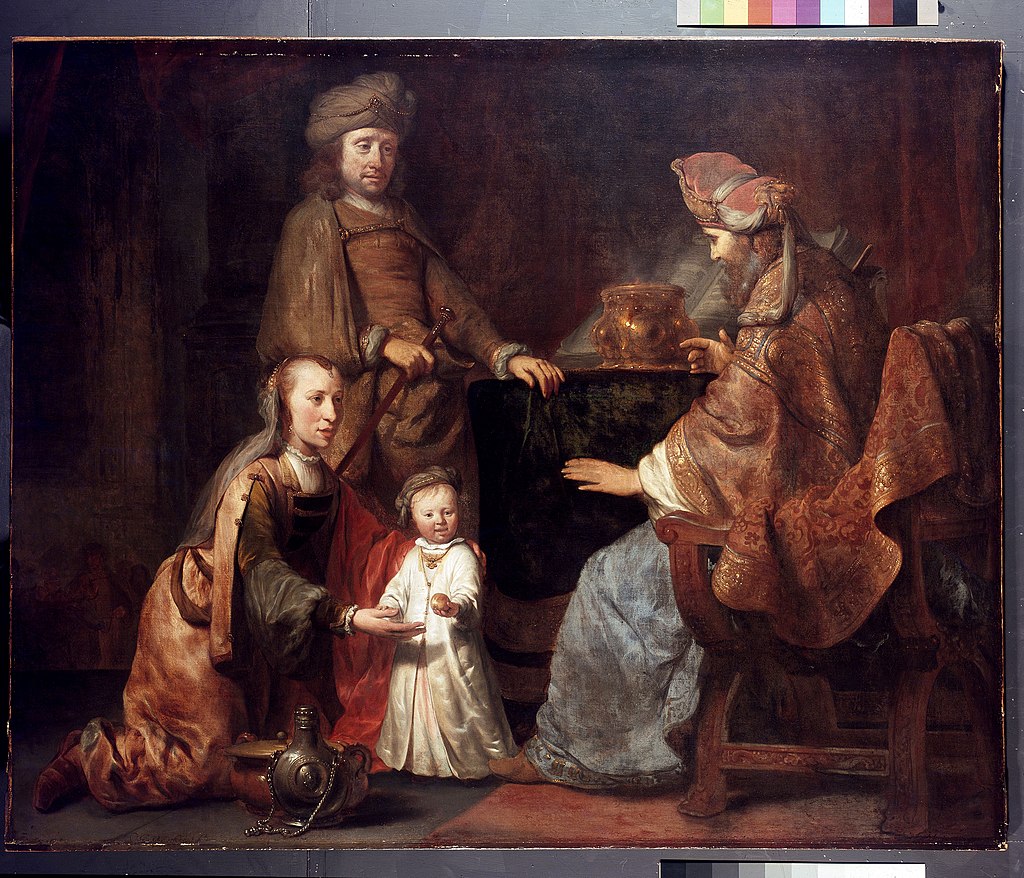
So, as a faithful mother, Hannah kept her vow to God. After Samuel was weaned, probably at the age of two or three (1 Samuel 1:22), Hannah fulfilled her promise. When she came to the house of the Lord at Shiloh, she told Eli the priest:

“As surely as you live, my lord, I am the woman who stood here beside you praying to the LORD. I prayed for this child, and the LORD has granted me what I asked of him. So now I give him to the LORD. For his whole life he will be given over to the LORD” (1 Samuel 1:26-27).

There are three interesting statements in Hannah’s story as a mother: Elkanah’s statement about Hannah’s situation, Hannah’s statement about her condition, and the writer’s statement about Hannah’s blessing.

Elkanah’s Statement

When Elkanah, Hannah’s husband, saw how unhappy Hannah was because she was barren, Elkanah would say to her, “Hannah, why are you weeping? Why don’t you eat? Why are you downhearted? Don’t I mean more to you than ten sons?” (1 Samuel 1:8).

The answer to Elkanah’s question was never given, but the reader almost can guess the answer.

Elkanah’s effort to try to comfort his wife was in vain. To a childless woman, a husband
really was not “better than ten sons,” because the joy of motherhood is different from that of conjugal happiness, and especially to a woman in Israel who had hoped to be delivered from her barrenness. After all, one could always find a husband but only the Lord could give a son.

Hannah’s Statement

After Hannah was blessed with her deliverance from sorrow and desolation, she sang a song of thanksgiving: “My heart rejoices in the LORD” (1 Samuel 2:1). Hannah’s outburst of joy came as a result of the divine favor she received in answer to her prayer. In her joy Hannah said: “She who was barren has borne seven children” (1 Samuel 2:5).

The expression “the barren has borne seven” expresses the joy that makes a barren woman the
mother of seven because it is the Lord who takes away barrenness: “The Lord settles the barren woman in her home as a happy mother of children” (Psalm 113:9).

Since seven represents completeness and perfection, seven becomes the representation of a perfect number of children, and a mother of seven is the happiest mother in Israel. When Ruth gave Naomi a descendant, the women of Bethlehem expressed Naomi’s joy in terms of seven sons:

“He shall be to you a restorer of life and a nourisher of your old age; for your daughter-in-law who loves you, who is more to you than seven sons, has borne him” (Ruth 4:15-16).

“The barren has borne seven.” Hannah was the happiest mother in Israel.

The Writer’s Statement

Now that “the barren hath borne seven,” Hannah understood that God had performed a miracle and that he could give her more children. Although at present Hannah had only one son and that son was given back to God, she hoped for more children and she was not disappointed.

“And the LORD was gracious to Hannah; she conceived and gave birth to three sons and two daughters” (1 Samuel 2:21).

The story of Hannah is the story of a woman who in her barrenness earnestly prayed to God with the longings of a mother’s heart, asking for a son. The experience of this mother who was bowed down and oppressed by her situation is an inspiring story to mothers everywhere on this Mother’s Day.

Other Posts on Mothers:

The Sons of Rizpah: Reflections on a Mother’s Love

The Mother of Seven

Deborah: A Mother in Israel

Claude Mariottini
Professor of Old Testament
Northern Baptist Seminary

Tags: , , , ,

Bookmark and Share

Labels: , , , ,

Sunday, April 19, 2009

The Child Samuel

Hushed was the evening hymn,
The temple courts were dark;
The lamp was burning dim
Before the sacred ark;
When suddenly a voice divine
Rang through the silence of the shrine.

The old man, meek and mild,
The priest of Israel, slept;
His watch the temple-child,
The little Levite, kept;
And what from Eli’s sense was sealed,
The Lord to Hannah’s son revealed.

Oh! give me Samuel’s ear!
The open ear, O Lord;
Alive and quick to hear
Each whisper of thy word:
Like him, to answer at thy call,
And to obey Thee first of all.

Oh! give me Samuel’s heart!
A lowly heart, that waits
Where in thy house Thou art,
Or watches at thy gates:
By day and by night, a heart that still
Moves at the breathing of thy will.

Oh! give me Samuel’s mind!
A. sweet, unmurmuring faith,
Obedient and resigned
To Thee in life and death;
That I may read, with childlike eyes,
Truths that are hidden from the wise.
(Anonymous)

Claude Mariottini
Professor of Old Testament
Northern Baptist Seminary


Tags: ,

Bookmark and Share

Labels: ,

Tuesday, August 14, 2007

1 Samuel 28: The Medium of Endor - Part 2

NOTE:

Today’s blog was written by Maggie Cole, one of my students at Northern Baptist Seminary. This article is the introduction to a larger paper, “The Medium of Endor: Hope for the Hopeless,” which Maggie wrote for my class OT 450 Women in the Old Testament. Maggie describes herself as a person with an insatiable curiosity focused on science and theology. Seeing no conflicts between the two, she enjoys a professional career as an applied ecologist who has worked in the natural resources management field for more than 20 years and has been a part-time student at Northern Baptist Seminary since 2005. Maggie is fascinated with the role of oral tradition in religion. At the present she is working on the Gilgamesh Epic. Maggie is married, has two teenage sons, and lives in the Chicago area.

Claude Mariottini
Professor of Old Testament
Northern Baptist Seminary


1 Samuel 28: The Medium of Endor - Part 2

The story in 1 Samuel 28:3-25 opens with a frustrated Saul who refused to accept that God’s will no longer provided him with any guidance, especially concerning his upcoming battle with the Philistines. Saul looked for a mistress of ancestral spirits, a necromancer, one who could raise the spirit of Samuel to assist him in his quest for knowledge.[1] However, Saul, as king, could not approach such a person openly, because he had condemned the very practice that he now desired to use. Therefore, Saul disguised himself so that the medium would not recognize him and flee. Here Saul is depicted as not only violating his own law but, by removing his royal garments to put on a disguise, he is portrayed as symbolically shedding his royal dignity.[2]

It is often mentioned by commentators of the text that, since Saul’s servants found the necromancer with ease, that this could indicate that she may have been well known in the community and that the practice of consulting the dead may have been a popular form of religious practice for many people in Israel.[3]

The actual encounter between the king and the necromancer indicates that the medium was willing to perform the act the king had requested.[4] The narrator gives the woman a voice in the matter to help the reader learn that, although she was willing, she also was suspicious, cautious and fearful. She said to the stranger that the king had “cut off the mediums and spiritists from the land” (1 Samuel 28:9), so she looked to her client for a sign of good faith that he would not reveal her actions to the wrong people.[5] Saul reassured her in Yahweh’s name that she was in no danger. Satisfied with his oath, the woman tends to her job. She summoned the dead, the prophet Samuel was raised and appeared to Saul, although the details concerning how this was accomplished are avoided by the narrator.

The narrator was careful to mention that when the medium saw Samuel, she screamed. The specific interpretation of this response is an important factor in determining her possible state of mind, the author’s intent, and the reader’s response to the text. Therefore, what caused her startling reaction has been studied at length.[6] The traditional interpretation is that her cry was a response to the persecutor-king being revealed. Others believe that the narrator was giving the woman a “spark of clairvoyance or intuition” in her ability to recognize Saul.[7] Others believe that it was Samuel who helped the medium recognize that the visitor was Saul.[8] Either way, when the woman saw the presence of this “elohim,” when she detected a great and awful force in the room, something unexpected happened to her. Whatever it was, the appearance of Samuel helped the medium recognize Saul whom she greatly feared.

In response to the medium’s recognizing Saul, the narrator again gives her a voice, presumably to chastise Saul for deceiving her. Saul reassured the woman and refocused her shattered attention to describing the vision, thus indicating she could see it but he could not. She called Samuel an “elohim,” a word which has been interpreted as meaning a divine or numinous being,[9] indicating a greater spirit. Saul asked for more details about the elohim and the woman described it as wearing a sacred, divine garment which clearly identified the being with the prophet Samuel.[10]

While Samuel and Saul were speaking to each other, the medium departed to the background of the narrative. Some scholars allow for the purposeful backing away of the medium, interpreting her removal as being the action of a good psychotherapist who “gives her client room for his own process,”[11] while others see her absence as being Samuel’s victory over her evil.[12] After Samuel reiterated Saul’s unworthiness, he added the prophecy that Saul and his sons would die on the battlefield the next day. Saul fell flat on the ground in distress, for he trusted Samuel’s words since they could only be truthful and prophetic.

At this point, it becomes important to ask who actually raised Samuel: the medium of Endor or Yahweh? It is possible to agree with those who claim the author intended for the readers to think the necromancer had the ability to do this amazing feat, but being a modern reader, I agree with those scholars who say that it was actually Yahweh who intervened on this unique occasion.[13] It was simply God’s will to speak to and answer Saul again through Samuel. I strongly disagree with any discussion that considers there was an evil force behind the raising of Samuel because the prophet could only work for Yahweh, even in death. Further, Yahweh did not break his own laws against necromancy nor did he condone necromancy by doing this. He just chose to exert his will which cannot be judged or boxed in by laws or human ideas. This event would not be the first time God did something that was contrary to our expectations of him.

After Samuel told Saul of his impending death, the medium returns to the story. Here the narrator allows her to be seen as a compassionate and caring host, and possibly even as a motherly figure. Apparently, after witnessing or sensing that something powerfully unique had happened, she understood Saul’s tremendous distress. She requested the king to listen to her, a woman, who sympathized with his fallen state.

The serving of the meal seems literarily appropriate here. Saul’s kingship began with a meal provided by Samuel (1 Samuel 9:19-24), now it ends with a meal served by “the prophetic mediator of Samuel’s word of doom.”[14] The medium offered Saul food which was initially rejected. By insisting that Saul eat, the woman became the “no-nonsense hostess,” evoking appropriate social protocol that eventually wins him over.[15] She prepared a fattened calf and unleavened bread for him to eat, a banquet which appeared to be fit for a king, a banquet that became the last supper for a condemned man.[16]

The reference to the fattened calf, or stall-fed calf, is unusual in the context of the story; it is possible that it has some symbolism attached to it. Some scholars believe the woman’s meal represents an idolatrous sacrifice used to “outwit and outmaneuver her adversary to save her own life.”[17] From the necromancer’s perspective, the slaughter was indicative of a cultic ritual leading to a blood meal offering to the dead.[18] On the other hand, since the medium was treating Saul with respect and dignity, it is also possible that she was offering a sacrificial meal fit for a dying king.[19] This act depicts the medium of Endor assisting Saul in the death process. The presence of the woman at night tending to a dying man can be seen as an acknowledgment of the natural order of things under God’s control.[20] In the end, the food strengthened him enough so that he could go on his way to face his final day.

From a theological, political, and literary perspective, the interpretation of these designated roles in the Bible make perfect sense. Overall, commentators usually interpret this story as showing Saul in his final days without any spiritual guidance. His consistent disobedience to Yahweh and the loss of his kingship had already occurred back in 1 Samuel 15 when Samuel first informed him of his impending fate. Chapter 28 serves as a rhetorical device to remind the reader that Saul is a pathetic, lost soul, who is disobedient to God and who seeks out a woman necromancer to engage in a practice that he himself supposedly outlawed. The entire story drives home the point of the biblical writer who wanted to depict Saul as a hypocrite and a most desperate man whose defiant behavior against Yahweh proved he was no longer fit to be king. Because of this overriding theme of diminishing Saul, the narrative has been interpreted by scholars as a Deuteronomistic polemic against Saul. However, even though Saul has no hope of living beyond the next day, the author saves Saul’s dignity in 31:11-13 when he declares that after his death, Saul’s body was claimed and returned to Jabesh Gilead for burial. Later, even David gets involved in saving Saul’s dignity by returning Saul’s bones to his father’s ancestral tomb (2 Samuel 21:13-14). Saul may have failed as a king, but he was given some level of respect in death.

Since biblical redactors are responsible for the final outcome of the text, this story served to demonstrate the reason Saul was a failed king. The author’s intent was to provide the reader with a protagonist in the character of the medium, but then he gives her the voice of a conscientious, compassionate person so that she will be contrasted with a disobedient king.

By showing the reader the necromancer’s compassionate acts and by restraining from outright condemnation of her practice, the writer was not trying to convey to the readers that the woman was good. 1 Samuel15:23 equates rebellion with divination.[21] The writer effectively projected necromancy into an older narrative specifically to have it condemned by a powerful prophet of Yahweh.[22] This projection purposely makes necromancy seem like an age-old battle for Israel even though it may have actually been tolerated for a long time.

The redactor’s purpose was to promote David. While he did this, he continued to denigrate Saul and eventually linked him to the illegal practice of necromancy. Most scholars point out that there were other legitimate means of consulting Yahweh, but necromancy totally fell out of favor. Perhaps this is because those who controlled Yahwism’s destiny wanted to silence their competition.

Maggie Cole

Tags: , , , , ,


Notes:

1. Diana V. Edelman, King Saul in the Historiography of Judah (JSOT Sup, 121: Sheffield: Sheffield Academic Press, 1991), 242.

2. J. P. Fokkelman, Narrative Art and Poetry in the Books of Samuel, Vol II (Assen:Van Gorcum & Company, 1986), 600

3. Fokkelman, Narrative Art and Poetry, 597.

4. Athlaya Brenner and Fokkelien Van Dijk-Hemmes, On Gendering Texts: Female and Male Voices in the Hebrew Bible ( Leiden: E.J. Brill, 1993), 67.

5. Fokkelman, Narrative Art and Poetry, 603.

6. K. Smelik, “The Witch of Endor: 1 Samuel 28 in Rabbinic and Christian Exegesis till 800 A.D.,” Vigiliae Christianae 33 (1979): 169-179.

7. Fokkelman, Narrative Art and Poetry, 607.

8. W.A.M. Bueken, “1 Samuel 28: The Prophet as Hammer of Witches.” Journal for the Study of the Old Testament 6 (1978): 8-9.

9. Fokkelman, Narrative Art and Poetry, 608.

10. Bledstein, Adrien Janis, “Tamar and the Coat of Many Colors,” in Samuel and Kings, ed. Athalya Brenner (Sheffield: Sheffield Academic Press, 2000), 72-73.

11. Fokkelman, Narrative Art and Poetry, 609.

12. W.A.M. Bueken, "1 Samuel 28," 8-9.

13. David Payne, I & II Samuel (Philadelphia: Westminster Press, 1982), 143-145.

14. Susan Pigott, “1 Samuel 28-Saul and the Not so Wicked Witch of Endor,” Review and Expositor 95 (1998): 440.

15.. Graeme Auld, “1 and 2 Samuel” in Eerdman’s Commentary on the Bible, ed. John Rogerson (Grand Rapids:Wm Eerdman’s Publishing Co, 2003), 228.

16. Fokkelman, Narrative Art and Poetry, 620.

17. Pamela T. Reis, “Eating the Blood: Saul and the Witch of Endor,” Journal for the Study of the Old Testament 73 (1997): 14.

18. Reis, Eating the Blood, 18.

19. Pigott, “1 Samuel 28-Saul and the Not so Wicked Witch,” 440.

20. Theresa Angert-Quilter and Lynne Wall, “The ‘Spirit Wife’ at Endor,” Journal for the Study of the Old Testament 92 (2001): 62.

21. Pigott, “1 Samuel 28-Saul and the Not so Wicked Witch,” 441.

22. Brian B. Schmidt, “The “Witch of Endor, 1 Samuel 28, and Ancient Near Eastern Necromancy,” in Ancient Magic and Ritual Power, ed. Marvin Meyer and Paul Mirecki (Brill: Leiden, 1995), 127.

Labels: , , , , ,

Monday, August 13, 2007

1 Samuel 28: The Medium of Endor - Part 1

NOTE:

Today’s blog was written by Maggie Cole, one of my students at Northern Baptist Seminary. This article is the introduction to a larger paper, “The Medium of Endor: Hope for the Hopeless,” which Maggie wrote for my class OT 450 Women in the Old Testament. Maggie describes herself as a person with an insatiable curiosity focused on science and theology. Seeing no conflicts between the two, she enjoys a professional career as an applied ecologist who has worked in the natural resources management field for more than 20 years and has been a part-time student at Northern Baptist Seminary since 2005. Maggie is fascinated with the role of oral tradition in religion. At the present she is working on the Gilgamesh Epic. Maggie is married, has two teenage sons, and lives in the Chicago area.

Claude Mariottini
Professor of Old Testament
Northern Baptist Seminary

1 Samuel 28: The Medium of Endor - Part 1

Over the centuries the woman from Endor in 1 Samuel 28 has been called a medium, necromancer, spiritist,[1] a raiser of spirits,[2], ghost wife,[3] a mistress of ghosts,[4] a witch, [5] and other names that depict the practitioner of a ritual that has become unacceptable in Judaism and Christianity. It is often assumed that she had to have been a law breaker, evil, a self preservationist,[6] and a demon communicator who “borrowed her resources not from herself, nor from the Lord her God, but from demons and from the mysterious forces of nature.”[7]

On the opposite end of the spectrum stand several more complimentary descriptions of this same woman such as the perfect hostess,[8] a wise woman,[9] a spirit wife,[10] a wifely character, [11] a compassionate, loyal, and even motherly character.[12] One has to wonder why this secondary character in 1 Samuel 28, the medium of Endor, demands so much attention from its scholarly and not-so scholarly readers. The purpose of this paper is to study some of the interpretations that address the medium’s literary function and purpose in 1 Samuel 28.

The book of Samuel is devoted to the rise of the Israelite monarchy beginning with Saul and David. It is at the end of Saul’s life that the Medium of Endor appears (1 Samuel 28). Essentially, the medium makes a brief appearance in the narrative about Saul’s kingship the night before the end of his life. Her role at this junction in the story is critical in demonstrating Saul’s total failure as a king.

Consistently, interpretations of 1 Samuel 28:3-25 focus on the events surrounding the death of Saul by the hands of the Philistines on Mount Gilboa. Indeed, when exploring this text, most readers are drawn more closely to the dilemma faced by Saul as he dealt with the Philistine threat and with David’s ambitions. Readers find it difficult to remain focused on the woman, the medium of Endor, because the biblical writers only intended for her to provide a window into the mind of Saul, which she does so beautifully. So well did the biblical writers accomplish their task that even the modern reader cannot help but view King Saul and the prophet Samuel as the primary focus of this story while the woman from Endor slips into a secondary character role whose entire existence is seen only in light of Saul’s story, especially his failure and demise.

To reach beyond the traditional interpretation of the text, a holistic exegesis requires that different perspectives be assumed when examining this story. Therefore, the interpretation of the text will begin by looking at the historical and cultural significance of the dreaded necromancer and address several questions raised by the text. These questions include whether the necromancer was a real person or a literary component simply added to enhance the story and how the answer to this question might affect what one thinks of her, and what crucial role this narrative played in explaining the circumstances surrounding the end of Saul’s life.

In order to fully appreciate the interaction between Saul, Samuel, and the medium of Endor, the woman who practiced necromancy, it is essential to understand not only what necromancy was, but why it was considered so evil in Israel. Necromancy, communicating with the dead, was presumably a popular way in Israel for people to consult with the spirits of the dead.[13] Necromancy is linked to ancestor worship and the cult of the dead.[14] The understanding of these practices among the people of Israel provides the proper background for understanding the issues raised in 1 Samuel 28.

A study of ancient cults of the dead shows that the practice of consulting the dead existed in a legitimate way in the ancient Near East and in early Israel. The possible origins and preservation of the practices associated with the cult of the dead are discussed in length by both Lewis[15] and Bloch-Smith.[16] Some scholars believe that necromantic practices were a part of Israel’s early religion.[17] The marked graves mentioned in Genesis 35:20 may have served as places for cultic activities, including consulting the dead.[18] Jacob is portrayed as pouring oil on spots where his ancestors’ deity appeared (Genesis 28:15-18; Genesis 35:13-14). Some texts demonstrate earlier traditions of caring for the dead, such as when Moses denied post-mortem care to the Korahites (Numbers 16:31-40). Ancestor sacrifice is even accepted by David (1 Samuel 20:6).

The dead were thought to have more power and knowledge than the living, and if someone could raise the dead to foretell the future, one could manipulate this power for one’s own benefit.[19] The conjuring up of Samuel is a good example of the practice of consulting the dead and this practice may have been accepted in Israel until the Deuteronomist and Priestly writers rejected the practice.[20] From a Deuteronomistic perspective, it is possible to understand that as the worship of Yahweh evolved, necromancy may have been eventually rejected because it interfered with the people’s effort to seek Yahweh’s will. It is also likely that necromancy became linked to the unacceptable Canaanite religion[21] or to practices found in Mesopotamia [22] As necromancy became associated more and more with foreign practices and as it was perceived as interfering with seeking God, then the practice of consulting the dead became synonymous with the magical practices of “outsiders.”

Magicians were considered to be “outsiders.” Magical actions themselves were not the focus of the biblical authors, but rather their focus lies on the conformity of the “outsider” to the Israelite religion.[23] Those whose “magical” practices deviated from the normally accepted Israelite practices were thought of as powered by something other than Yahweh, a practice which undermined the religious foundations of Israelite religion.[24] The understanding of this concept is crucial in the proper understanding of the medium and her work and how she was portrayed by the authors whose motives may have been related to the failures of Saul as king. The medium’s mere presence in an oracle of doom against Saul demonstrates her popular status in the community[25] and provides a hint at the popularity of necromancy in Israel.

Scholars see this section of the book as “deuteronomistic narrative material.”[26] Some scholars favor the view that this narrative is “a literary construct of the mid-first millennium” linked to 1 Samuel 15 and thus to the Deuteronomist and his redaction of the book.[27] According to this view, total rejection of necromancy in Israel is thought to have reached a pinnacle about the time the practice became connected with Israel’s worst king, Manasseh.[28] After the Book of the Law was discovered in the Temple during Josiah’s reform, attempts to discredit the practice of necromancy may have resulted in the redaction of many earlier writings. The Deuteronomic reform introduced legislation condemning the practice and purposely introduced necromancy into the narrative so that Saul and the practice of consulting the dead would be condemned by Samuel.[29]

There is, however, evidence of older laws against black magic found as early as the Covenant Code: “You shall not permit a female sorcerer to live” (Exodus 22:18). The Priestly law condemned those who practiced necromancy in Israel: “A man or woman who is a medium or spiritist among you must be put to death” (Leviticus 20:27).[30]

In addition, a medium’s presence among the Israelites becomes a source of defilement: “Do not turn to mediums or seek out spiritists, for you will be defiled by them” (Leviticus 19:31). Since the work of mediums and sorcerers was considered an opposition to God’s work, warnings to those who would seek out band listen to them are found in Deuteronomy 18:10-11; Micah 5:12; and Jeremiah 27:9. For instance, Deuteronomy 18:10-11 says: “Let no one be found among you who practices divination or sorcery, interprets omens, engages in witchcraft, or casts spells, or who is a medium or spiritist or who consults the dead.” The Chronicler, however, makes a special point of linking Saul’s death with his consultation of a necromancer (Chronicle 10:13-14).

There is evidence in the Old Testament to suggest that necromancy may have been an old popular religious practice in Israel. The practice of consulting the dead was tolerated in Israel in the same way the worship of foreign deities was tolerated. This practice, however, found strong opposition from the Deuteronomic historian who used the practice to diminish Saul’s kingship by associating him with the practice of necromancy. The rejection of the practice of consulting the dead by Samuel may be an indication that the story of the medium of Endor probably was a literary addition to Saul’s narrative for apologetic purposes. Also, since the case of the medium of Endor is the only biblical example of the practice of necromancy that is seen as “uncontested” by the narrator, this has lent further credence to the conclusion that the medium was only used as a rhetorical device by the redactor to characterize Saul’s doom.[31]

Maggie Cole

Tags: , , , , ,

Notes:

1. Bill Arnold, “Necromancy and Cleromancy in 1 and 2 Samuel,” Catholic Biblical Quarterly 66 (2004): 200.

2. Athlaya Brenner and Fokkelien Van Dijk-Hemmes, On Gendering Texts: Female and Male Voices in the Hebrew Bible ( Leiden: E.J. Brill, 1993), 68.

3. Tony Cartledge, 1 and 2 Samuel (Macon: Smyth & Helwys Publishers, 2001), 320.

4. J. P. Fokkelman, Narrative Art and Poetry in the Books of Samuel, Vol II (Assen:Van Gorcum & Company, 1986), 607.

5. Pamela T. Reis, “Eating the Blood: Saul and the Witch of Endor,” Journal for the Study of the Old Testament 73 (1997): 3.

6. Reis, Eating the Blood, 4.

7. Abraham Kuyper, Women of the Old Testament (Grand Rapids: Zandervan, 1936), 100.

8. Cheryl Brown, No Longer Be Silent: First Century Jewish Portraits of Biblical Women (Louisville: Westminster/John Knox Press, 1992), 201.

9. Brenner and Van Dijk-Hemmes, On Gendering Texts, 69.

10. Theresa Angert-Quilter and Lynne Wall, “The ‘Spirit Wife’ at Endor,” Journal for the Study of the Old Testament 92 (2001): 60.

11. Alice Bach, Woman, Seduction, and Betrayal in Biblical Narrative (Cambridge: Cambridge University Press, 1997), 176.

12. Fokkelman, Narrative Art and Poetry, 620.

13. Fokkelman, Narrative Art and Poetry, 597.

14. Arnold, Necromancy and Cleromancy, 203.

15. Theodore J. Lewis, Cults of the Dead in Ancient Israel and Ugarit (Atlanta: Scholars Press, 1989).

16. Elizabeth Bloch-Smith, Judahite Burial Practices and Beliefs About the Dead (JSOT Sup, 123; Sheffield: Sheffield Academic Press, 1992).

17. Arnold, Necromancy and Cleromancy, 201.

18. Bloch-Smith, Judahite Burial Practices, 113.

19. Lewis, Cults of the Dead, 102.

20. Bloch-Smith, Judahite Burial Practices, 127.

21. Lewis, Cults of the Dead, 102.

22. Brian B. Schmidt, “The “Witch of Endor, 1 Samuel 28, and Ancient Near Eastern Necromancy,” in Ancient Magic and Ritual Power, ed. Marvin Meyer and Paul Mirecki (Brill: Leiden, 1995), 118.

23. Stephen D. Ricks, “The Magician as Outsider in the Hebrew Bible and the New Testament.” in Ancient Magic and Ritual Power, ed. Marvin Meyer and Paul Mirecki (Brill: Leiden, 1995), 131-132.

24. Ricks, The Magician as Outsider, 132, 134.

25. Ricks, The Magician as Outsider, 138.

26. Lewis, Cults of the Dead, 104.

27. Schmidt, The Witch of Endor, 112-114.

28. Graaeme Auld, “1 and 2 Samuel,” Eerdman’s Commentary on the Bible, ed. John Rogerson (Grand Rapids:Wm Eerdman’s Publishing Co, 2003), 228.

29. Schmidt, The Witch of Endor, 127.

30. Lewis, Cults of the Dead, 99.

31. Arnold, Necromancy and Cleromancy, 199.

Labels: , , , , ,