
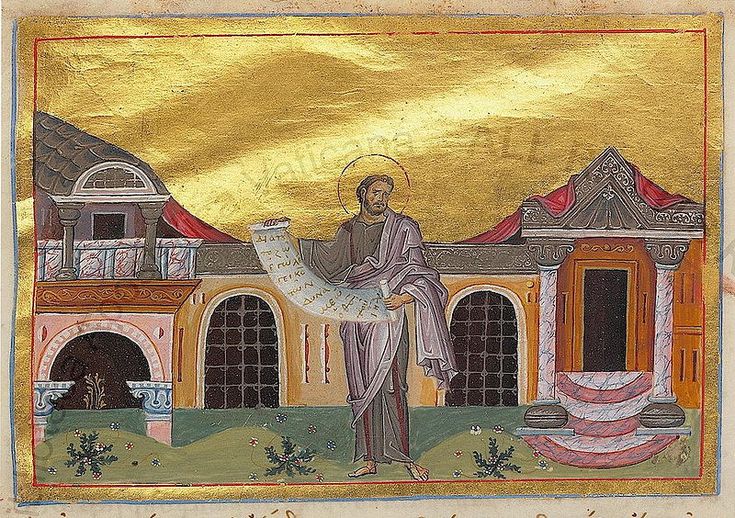
The Prophet Zephaniah
Menologion of Basil II
(11th Century)
Today I begin a series of studies on the prophet Zephaniah. Zephaniah was one of the twelve minor prophets in the Hebrew Bible. He is not as well known as Amos, Hosea, or Micah. Zephaniah was called by YHWH to proclaim his message to the people of Judah in the days prior to the reforms of Josiah in the seventh century (640 B.C.).
Zephaniah’s message spoke against the idolatry and political corruption in Judah that was offensive to God. His message was also focused on the Day of YHWH, a day when YHWH will come to judge his people and judge the nations. To Zephaniah, the Day of the Lord was approaching and his message was a call to the righteous remnant of Judah to prepare for that terrible day.
Before one can adequately understand the message and ministry of Zephaniah, it becomes necessary to gain a basic understanding of the prophetic traditions in Israel. Since its inception in the days of Samuel, who is considered the founder of the prophetic movement in Israel, prophecy was an integral part of the social and religious life of Israel.
The primary word used in the Hebrew Bible to designate a prophet is nabi, a word meaning “one who is called.” Before the classical prophets (or the writing prophets) arose in Israel, most of the prophets of Israel were visionaries. Another word for prophet was ro’eh, a word which means “one who sees.” But after the visionaries fell into disrepute, the seer was displaced by the prophet, but the ministry of the visionaries never truly disappeared in Israel.
This transformation of prophecy in Israel is seen in the statement of 1 Samuel 9:9: “In Israel, back in the old days, when someone went to consult God, he would say, ‘Come, let’s go to the seer,’ because a person now called a prophet used to be called a seer.”
The primary mission of the prophets in Israel was to proclaim the Word of God. They spoke to their own society in order to call the people back to the religion of Yahweh, urging them to repent and to be faithful to the demands of the covenant. And as they proclaimed God’s Word to Israel, the prophets dealt with the religious, political, moral, and social problems that plagued their society.
The prophets did not speak by their own authority. They considered themselves to be God’s instruments. The words they proclaimed to the people came directly from God. The prophets were not divining the future. They spoke against the ills they encountered in their society. They were not social reformers, speaking out against the evils of society, but they believed that the social problems in their society were the result of the people’s violation of the demands of the covenant.
The prophets were not educated theologians trained in prophetic schools. They believed they had received their message directly from God. The prophets were men and women filled with the Spirit of God, people who had a compulsion to speak on behalf of their God. The prophets believed what gave them the authority to speak on behalf of God was a sense of calling, that YHWH had sent them to their society with a message that the people needed to hear.
Early in the prophetic movement in Israel, the prophets formed prophetic guilds and used music and musical instruments to help them acquire prophetic inspiration. After Samuel anointed Saul, Samuel told the newly anointed king: “After that you will go to Gibeah of God, where there is a Philistine outpost. As you approach the town, you will meet a procession of prophets coming down from the high place with lyres, tambourines, flutes and harps being played before them, and they will be prophesying” (1 Samuel10:5).
The prophets were led by a leader known as “the father.” The members of the group were called the “sons of the prophet.” In 2 Kings 2:12, Elisha addressed Elijah by the title “My father.” The followers of Elisha were called “the sons of the prophets” (2 Kings 2:3).
Many of the early prophets served either as cult prophets or court prophets. The cult prophets were attached to various shrines or places of worship in Israel. They not only functioned as prophets, but probably also served in the priestly capacity by offering sacrifices or exercising other religious functions. Samuel was a prophet (1 Samuel 19:20), but he also offered sacrifices unto the Lord (1 Samuel 16:2).
The court prophets served in the king’s court and were at the king’s service. These court prophets were consulted before the king went into battle. Ths work of the court prophets is seen in 1 Kings 22:6: “So the king of Israel gathered the prophets, about 400 men, and asked them, ‘Should I go against Ramoth-gilead for war or should I refrain?’ They replied, ‘March up, and the Lord will hand it over to the king.’” The cult prophets received their compensation from the temple treasury while the court prophets were paid from the king’s wealth.
There was another group of prophets in Israel who was not associated with the temple nor with the court. These prophets were independent of religious and political organizations. Prophets such as Micaiah, Elijah, and Elisha were operating on their own, probably supported by the community, and did not receive any special benefits either from the temple or from the king. They are often known as “peripheral prophets.” Sometimes these independent prophets became leaders of prophetic communities. For instance, Elijah was the leader of a prophetic community from which Elisha came. Isaiah mentions the disciples who were involved in his ministry (Isaiah 8:16).
As mentioned above, the prophets spoke with divine authority. Their message was received from YHWH to be communicated to the people. One of the primary functions of a prophet was to intercede with YHWH on behalf of the people. Before a prophet proclaimed his message to the people, he stood in the “council of YHWH” so that he could see and hear what the Lord had said and receive instructions on what to proclaim to the people (see Jeremiah 23:18).
One of the main reasons why the canonical or writing prophets arose in Israel was because of the problem of false prophets. From almost the beginning of the prophetic movement in Israel until the post-exilic times, many prophets appeared in Israel claiming to speak on behalf of the Lord. These prophets called themselves “nabi,” “prophets,” but their message contradicted the message of the true prophets of YHWH. For instance, the message of Zedekiah contradicted the message of Micaiah (1 Kings 22:11-13). The message of Hananiah contradicted the message of Jeremiah (Jeremiah 28).
The reason the prophets wrote down their words or oracles in a scroll was to vindicate their ministry and to serve as a reminder to future generations that they were speaking the truth and that their oracles were fulfilled. It was in the fulfillment of the prophetic word that the people would recognize that a prophet had spoken the truth on behalf of YHWH. As Jeremiah told Hananiah: “As for the prophet who prophesies peace, when the word of that prophet comes to pass, then it will be known that the LORD has truly sent the prophet” (Jeremiah 28:9).
When Isaiah’s message was rejected by king Ahaz, the prophet said: “Tie up the scroll as legal evidence, seal the official record of God’s instructions and give it to my followers. I will wait patiently for the LORD, who has rejected the family of Jacob; I will wait for him” (Isaiah 8:16-17). Because the people of Judah had refused to listen to his message, God told Jeremiah to write down in a book all the words he had preached. So, at the dictation of Jeremiah, Baruch wrote down in a scroll all the word of the Lord, so that Jeremiah’s message would remind the king and the people of Judah of the coming judgment (Jeremiah 36:1-4).
Thus, the prophets wrote down their words in order to remind the people that they spoke on behalf of YHWH. Their message told the people what God was doing in their world, urging Israel to change their ways, calling the people to repent and to recommit themselves to the covenant which they had made with YHWH.
STUDIES ON THE PROPHET ZEPHANIAH
The Historical Context of Zephaniah’s Ministry
Zephaniah and the Judgment of God
Zephaniah and the Palestinians
Claude Mariottini
Emeritus Professor of Old Testament
Northern Baptist Seminary
NOTE: Did you like this post? Do you think other people would like to read this post? Be sure to share this post on Facebook and share a link on Twitter or Tumblr so that others may enjoy reading it too!
I would love to hear from you! Let me know what you thought of this post by leaving a comment below. Be sure to like my page on Facebook, follow me on Twitter, follow me on Tumblr, Facebook, and subscribe to my blog to receive each post by email.
If you are looking for other series of studies on the Old Testament, visit the Archive section and you will find many studies that deal with a variety of topics.













 Dr. Claude Mariottini - Professor of Old Testament
>Wow – I wish I had taken a prophets class from you in Seminary now, Dr. Mariottini. I loved your class on Psalms, but clearly your understanding and explanations of the prophets would have been a pleasure to sit-in on when I had you for classes. Any chance you'll offer a class on the prophets online for Northern?
LikeLike
>Joshua,I am happy to know that you enjoyed my post on the prophets.Unfortunately, I am not teaching an online class on the prophets next year. I will be teaching the Major Prophets next Spring Quarter on campus. Come and join us, if you can.Claude Mariottini
LikeLike
l benefited a lot from your from this article of prophets.thanks
LikeLike
Gwinyai,
Thank you for visiting my blog. I am happy to know that you enjoyed my post.
I hope you have subscribe to my blog so you can receive all my posts by mail.
Claude Mariottini
LikeLike
Thank you for the article Dr Mariottini, I need clarity especially on peripheral prophets. God bless you.
LikeLike
Nkosinathi,
I am glad you enjoyed the post on the prophets. There is much we can learn from them.
Claude Mariottini
LikeLike
Insightful. Thanks
LikeLike
Samuel,
Thank you for your nice words and thank you for visiting my blog.
Claude Mariottini
LikeLike