
Nefertiti was one of the most famous women of all ancient Egypt. She was the wife of Akhenaten. Her name means “the beautiful woman has come.” Her bust can be seen in the Egyptian Museum in Berlin. Not much is known about her. She appeared with Akhenaten during his fourth year at el-Amarna, which was Akhenaten’s new city.
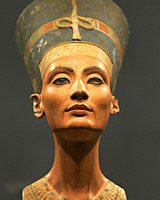
One peculiar characteristic of Nefertiti’s famous bust is the shape of her eye. In an article published in Archaeology, Earl L. Ertman wrote:
One of the earliest appearances of Nefertiti’s unusual eye shape is on a stela showing the royal family. Found at Amarna and now in Berlin, it is dated by an inscription to before years 8 through 12 of Akhenaten’s reign, or around 1350 B.C. On the stela, however, Akhenaten’s eye shape is “normal” and resembles those seen on sculptures of him in Thebes, but Nefertiti’s is not. So this stela may show a real, physical condition.
It could be that Nefertiti had an epicanthic fold, a piece of skin from the upper eyelid covering the inner edge of the eye. This feature is found not just in people of East Asian descent, but also in individuals with a number of different syndromes–groups of symptoms characteristic of an abnormality–some of which are genetically based. Some syndromes are debilitating, others less so, and still others are passed only from mothers to daughters.
The article on Nefertiti’s eye was published in the March-April issue of Archaeology and it is available free online.
Claude Mariottini
Emeritus Professor of Old Testament
Northern Baptist Seminary
NOTE: Did you like this post? Do you think other people would like to read this post? Be sure to share this post on Facebook and share a link on Twitter so that others may enjoy reading it too!
I would love to hear from you! Let me know what you thought of this post by leaving a comment below. Be sure to like my page on Facebook, follow me on Twitter, Facebook, and subscribe to my blog to receive each post by email.














 Dr. Claude Mariottini - Professor of Old Testament