
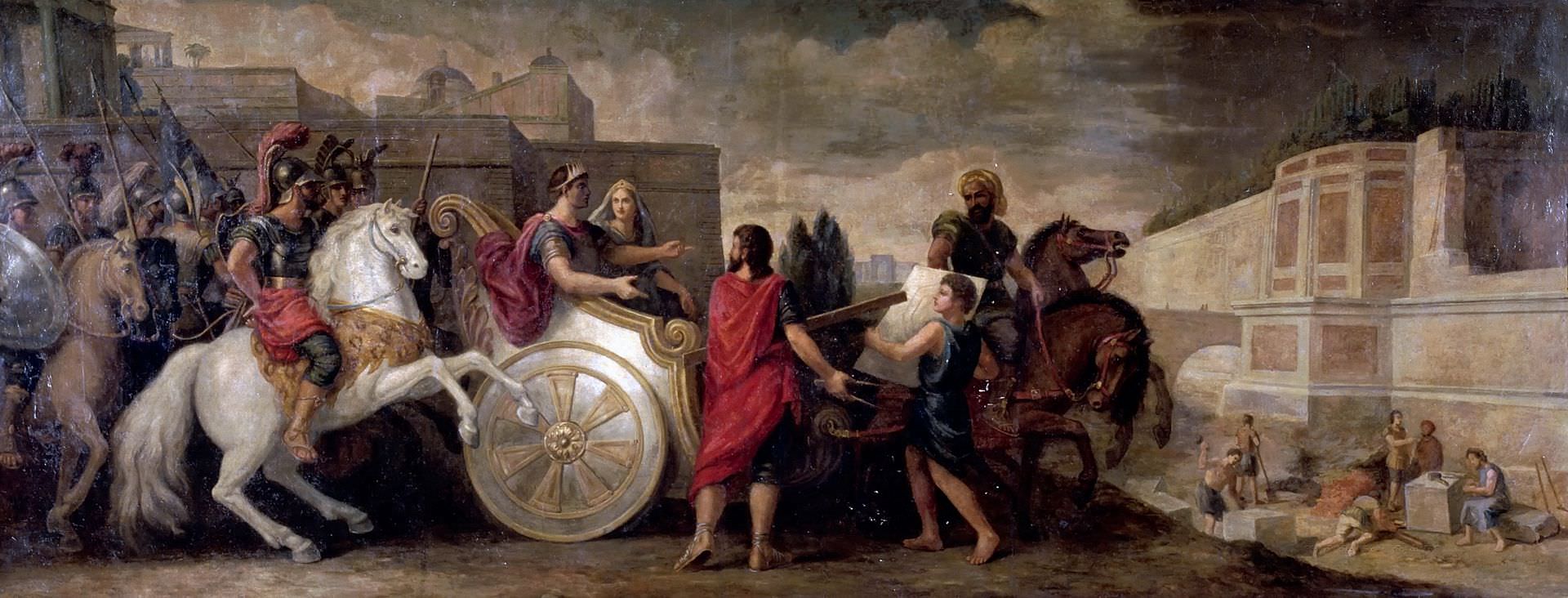
Nebuchadnezzar Ordering the Construction of the Hanging Gardens of Babylon
by Rene-Antoine Houasse (1676)
Wikimedia Commons
Nebuchadnezzar II, the Neo-Babylonian Empire’s second king, was the most famous king of the Chaldeans, a people whom Jeremiah called “an ancient nation” (Jer. 5:15). As king, Nebuchadnezzar brought fame and prosperity to the Empire. Of all the foreign kings the Old Testament mentions, this Nebuchadnezzar is the most prominent and the one with which Bible students are most familiar. Nebuchadnezzar reigned from 605-562 B.C.
The Kingship of Nebuchadnezzar
Nebuchadnezzar had a reputation as a great builder. He boasted that Babylon was a “great” city that he built to be his royal city and the capital of his empire (Dan. 4:30). Nebuchadnezzar built the Ishtar Gate, a magnificent palace for himself; he rebuilt the ziggurat (a temple in the form of a pyramidal tower) and he built a temple for Marduk, the chief god of the Babylonian pantheon. His best-known project was Babylon’s Hanging Gardens, which he built for his wife, Amystis, the daughter of the king of Media.
According to Babylon texts, Nebuchadnezzar received praise as a lawgiver, a judge, and a king who was devoted to justice and who opposed injustice and corruption. His motivation for fairness was to please his god, Marduk, and to thus enjoy a long life:
“O Marduk, my lord, do remember my deeds favorably as good [deeds], may (these) my good deeds be always before your mind (so that) my walking in Esagila and Ezida–which I love–may last to old age.”
Nebuchadnezzar’s name appears in two different forms in the Old Testament. In the King James Version, “Nebuchadnezzar” appears 55 times–“Nebuchadrezzar” 33 times. Since the official Babylonian documents use Nebuchadrezzar to designate the king of Babylon, this must be the name’s original and official form. Traditionally, the name Nebuchadnezzar has been translated “Nabu protect the boundary.” Recent studies of Babylonian documents have produced another
possible translation, “Nabu protect the crown prince.”
Nebuchadnezzar’s father, Nabopolassar led a Chaldean revolt against the Assyrians and in 626 B. C. founded the Neo-Babylonian Empire. After establishing an alliance with the Medes, Nabopolassar and his allies besieged Nineveh, the capital of the Assyrian Empire. After a three-month siege of the city, they conquered it in 612 B.C. The remnant of the Assyrian army retreated to Haran where they were defeated in 610 B.C. The Assyrians made a last effort to stop the Babylonian army, retreating to Carchemish to confront them one last time.
During the struggle between Assyria and Babylon, Neco ascended to the throne of Egypt and became king in 609. In an attempt to stop the advance of the Babylonian army, Neco prepared his army and went up to the Euphrates River to aid Assyria in their struggle against Babylon (2 Kings 23:29). On his way to Carchemish, Neco was confronted at Megiddo by Josiah, king of Judah, who had taken the side of Babylon. In the struggle that ensued, Neco killed Josiah (v. 29; 2 Chron.35:20-24). Neco was detained at Megiddo long enough to allow the Babylonians to defeat the remnant of the Assyrian army at Carchemish.
In 605 B.C., Neco returned to the area with ambitions of extending his rule in Mesopotamia. Nabopolassar, unable to fight because of the illness that eventually killed him, sent his oldest son Nebuchadnezzar to confront the Egyptians. At Carchemish the decisive battle between Nebuchadnezzar and Neco took place. Nebuchadnezzar soundly defeated Neco and subjugated Sidon, Tyre, the Philistia and other countries in Syro-Palestine (see Jer. 46:2; 47:2-7).
At this time Nebuchadnezzar received notice of his father’s death. Nebuchadnezzar left the army in the hands of his field commanders and returned to Babylon where he was crowned king of Babylon in 605 B.C.
Nebuchadnezzar in the Book of Kings
The Old Testament presented more than one view of Nebuchadnezzar. The book of Kings presents him as Jerusalem’s conqueror . After his victory against Egypt at the battle of Carchemish, Nebuchadnezzar made Jehoiakim, king of Judah, a vassal of Babylon. Jehoiakim submitted to Nebuchadnezzar for three years (604-601 B.C.). In 601 B.C., Egypt and Babylon met again with heavy losses on both sides. Nebuchadnezzar returned home to reorganize his army. Jehoiakim, counting on Egyptian help, revolted against the Babylonians (2 Kings 24:1).
Nebuchadnezzar did not campaign against Palestine from 600-598 B.C. Unable to fight against Judah, Nebuchadnezzar sent mercenary soldiers to fight against Jehoiakim (vv. 2-3). In 598 B.C., Babylon advanced against Judah. Egypt promised to help Jehoiakim, but Egypt’s military help did not materialize (v. 7 ). Jehoiakim died at this time; Jeremiah 22:18-19 and 36:30 suggest that he was assassinated. Jehoiakim’s son, Jehoiachin was made the new king of Judah (597 B.C.), but three months later he submitted to Nebuchadnezzar–who then deported to Babylon the king of Judah, his mother, the royal family, the palace officials, the army officers, fighting men, craftsmen, and smiths. He also took all the men of substance and all the men who were capable of war. According to 2 Kings 24:12-16, 10,000 people were taken into exile. Nebuchadnezzar also took all the temple and palace treasures and broke all the golden vessels used in temple worship. Jehoiachin remained in a prison in Babylon for 37 years, until Evil-merodach, Nebuchadnezzar’s son, freed him (2 Kings 25:27-30; Jer. 52:31-34).
In 596 B.C., Nebuchadnezzar placed Zedekiah on Judah’s throne as the new king. Zedekiah served Nebuchadnezzar eight years, but in his ninth, maybe hoping for military help from Egypt (Jer. 37:5), Zedekiah rebelled against Babylon. In 588 Nebuchadnezzar came back to Jerusalem and once again besieged the city. Archaeology has confirmed the scope Nebuchadnezzar’s invasion of Judah. Archaeology has revealed that many of Judah’s fortified cities were destroyed. In March 586 B.C., the Babylonians conquered Jerusalem and burned the temple as well as the great houses of the city. At this time a second deportation took place. Judah’s most important people were taken into exile; only the poorest were left behind.
Nebuchadnezzar in the Book of Jeremiah
The book of Jeremiah differs somewhat in its interpretation of Nebuchadnezzar and his assault on Judah. Presenting a more than mainly-historical account of the book of 2 Kings, Jeremiah offers an expanded interpretation that affirms the sovereignty of God and His guidance of Judah’s destruction. In the past Jeremiah had proclaimed that God would send the “people of the north” to bring judgment upon Judah (Jer. 25:9 NIV). Now for the first time Jeremiah proclaims that the foe from the north was Babylon, under the leadership of Nebuchadnezzar (vv. 1-9).
In the book of Jeremiah, the Lord referred to “my servant” Nebuchadnezzar “ three times (Jer. 25:9; 27:6; 43:10). Old Testament writers generally used the title “Servant of Yahweh” to designate persons who had a special relationship with God and who were obedient to God’s will in the life of His people.
Jeremiah designated Nebuchadnezzar the “Servant” of God as a way to present Babylon’s king as the individual God appointed to have dominion over the nations and the one who would act as the instrument of God’s justice (Jer. 25:8-11). Because Nebuchadnezzar was acting as God’s agent, Jeremiah declared to the people that rebellion against Nebuchadnezzar was rebellion against God. The Lord commands Jeremiah to write his oracles on a scroll as a warning to Judah (Jer. 36:1-4). According to Jeremiah, Nebuchadnezzar’s conquest and subjugation of the nations would happen with God’s approval:
“Now I will hand all your countries over to my servant Nebuchadnezzar king of Babylon; I will make even the wild animals subject to him. All nations will serve him and his son and his grandson until the time for his land comes; then many nations and great kings will subjugate him (Jer. 27:6-7 NIV).
In Jehoiakim’s 5th year of (604 B.C.), the people of Judah held a fast to avert a possible Babylonian invasion (Jer. 36:9). At the time of the fast, Baruch, Jeremiah’s scribe, read the words of the scroll to the people assembled in the temple (v. 10) and to the king (vv. 20-26). Jehoiakim refused to repent and burned Jeremiah’s scroll. In spite of the fast, Babylon invaded Judah and Jehoiakim submitted to Nebuchadnezzar in 604 B.C. (2 Kings 24:1).
In the book of Jeremiah, Nebuchadnezzar is God’s instrument to bring divine judgment to Judah. In the past, God had sent his servants the prophets to warn the people to repent of their evil ways, but they refused (25:4). Now, God is sending his “servant” Nebuchadnezzar to punish Judah for their wickedness. Judah and the nations of Syro-Palestine have to submit themselves to Nebuchadnezzar; refusal to submit means destruction (see 27:8).
Nebuchadnezzar and Yahweh
The picture that Jeremiah paints of Nebuchadnezzar reflects the prophet’s understanding of God’s work. Jeremiah understood that Yahweh had given Nebuchadnezzar the power and the authority to subjugate kingdoms and nations. As the instrument of God’s judgment, Nebuchadnezzar was God’s chosen agent, God’s servant who brought judgment over God’s rebellious people. In the end, the biblical tradition says that Nebuchadnezzar came to the realization that the God of Israel was the supreme God (Dan. 2:47; 3:28-29).
Jeremiah, portrayed Nebuchadnezzar as the servant of the God of Israel–a chosen individual who had “the responsibility of performing a designated function in Yahweh’s behalf.”
NOTE: For a comprehensive collection of studies on the prophet Jeremiah, read my post Introduction to the Book of Jeremiah.
Claude Mariottini
Emeritus Professor of Old Testament
Northern Baptist Seminary
VISIT MY AMAZON AUTHOR’S PAGE
BUY MY BOOKS ON AMAZON (Click here).
NOTE: Did you like this post? Do you think other people would like to read this post? Be sure to share this post on Facebook and share a link on Twitter or Tumblr so that others may enjoy reading it too!
I would love to hear from you! Let me know what you thought of this post by leaving a comment below. Be sure to like my page on Facebook, follow me on Twitter, follow me on Tumblr, Facebook, and subscribe to my blog to receive each post by email.













 Dr. Claude Mariottini - Professor of Old Testament
>Thank you for the article, Dr. Mariottini. I plan to read it to my Junior High Sunday School class ( http://www.countrybiblechurch.org ) this morning. We have just begun a study of Daniel, and want to get beyond the stories in Daniel that have been taken out of the book and sanitized for children.Thank you,Richard D.
LikeLike
>Dr. Mariottini, I came across your article about Nebuchadnezzar and Egypt. I'd like to ask about Ezekiel 29:10-30:19's prophecy regarding Egypt's desolation. It appears God would use Nebuchadnezzar (29:19-20, 30:10-11) to do this. Could you help me find archaeological corroboration of this event?Sorry, I know it's an old article; but it sounded as if you would be able to help me with this question if anyone could! Thanks & God blessMike
LikeLike
>Dear Mike,I apologize for the delay in answering your request. Nebuchadnezzar invaded Egypt in the 37th year of his reign during the reign of Amasis, king of Egypt. The information about Nebuchadnezzar’s invasion of Egypt is fragmentary. Try these sources:James B. Pritchard, Ancient Near Easter Texts (ANET), p. 308Donald J. Wiseman, Chronicle of the Chaldean Kings, 94-95I hope this information will help you.Thank you for visiting my blog.Claude Mariottini
LikeLike