
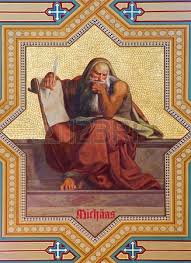
Micha the Prophet
Micah is one of my favorite prophets in the Old Testament. The reason I enjoy teaching the book of Micah is because he was a prophet who took the side of the oppressed and preached a message of judgment and hope to the people of Jerusalem.
Whenever one reads the book of Micah, one is surprised that very little is said about this spokesman for God. However, his prophecy left an indelible mark in the prophetic tradition of Israel. Outside his own book, Micah is mentioned in Jeremiah 26:17-19, during the trial of the prophet Jeremiah.
On that occasion, some of the elders of Judah invoked the ministry of Micah and his message of judgment to remind the leaders of Judah that Jeremiah, just like Micah, had preached the destruction of Jerusalem:
“And some of the elders of the land arose and said to all the assembled people, ‘Micah of Moresheth, who prophesied during the days of King Hezekiah of Judah, said to all the people of Judah: Thus says the LORD of hosts, Zion shall be plowed as a field; Jerusalem shall become a heap of ruins, and the mountain of the house a wooded height’” (Jeremiah 26:17-18).
The elders, then, reminded the people in the temple that Hezekiah and the people of Judah did not put Micah to death. Instead, they feared the Lord, prayed for God’s favor, and as a result, the Lord change his mind and did not bring about the judgment that Micah had pronounced against the city and against the temple (Jeremiah 26:19). Jeremiah’s life was spared because his message was similar to the message that Micah had proclaimed almost a century earlier.
According to the superscription of Micah’s book (Micah 1:1), his prophetic ministry occurred during the reigns of Jotham, Ahaz, and Hezekiah, kings of Judah. This means that Micah was active in the latter part of the eighth century B.C. and that he preached at the same time the prophet Isaiah was preaching in Jerusalem.
According to the chronology of the kings of Judah, Jotham became king in 742 B.C. and Hezekiah died in 686 BC. However, it is doubtful that Micah’s prophetic career lasted fifty-five years. Since Micah makes reference to the coming destruction of Samaria, most scholars believe that Micah’s ministry began a few years before Samaria was conquered in 722 B.C.
Micah’s message condemns the oppression of the poor, the political corruption of the leaders of Judah, and some of the religious syncretism that was common during the reign of Ahaz. The reference to Micah in Jeremiah 26:17-19 states that Micah prophesied “during the days of King Hezekiah.” Thus, many scholars believe that Micah’s message was one of the factors that prompted Hezekiah to initiate the religious reforms that removed some of the pagan practices that had been introduced into the religious life of Judah.
Micah’s name is probably an abbreviation of “Micaiah” (see 1 Kings 22:8). His name means “Who is like Yahweh?” This name probably reflects the Yahwistic faith of his parents who probably were deeply committed to the traditions of the covenant between God and Israel.
Micah’s birth place was Moresheth. This place is to be identified with the village of Moresheth-gath mentioned in Micah 1:14. This means that Moresheth was a satellite of Gath and that it was located in the Shephelah. Micah’s hometown was a small rural village located about twenty-five miles southwest of Jerusalem, just outside the Philistine city of Gath.
Little is known about Micah’s family and about his personal life. In the introduction of his book, he is introduced as “Micah the Morasthite” (Micah 1:1 KJV). In his commentary on Micah, Mays says that Micah’s identification as a Morasthite indicates that Micah was someone who lived outside of Jerusalem. This implies that Micah came from his village to speak God’s message to the residents of Jerusalem.
In addition, since the name of his father is not mentioned in the introduction of his book and that he is only identified by the village in which he lived, most scholars believe that he was a peasant, a person of no importance in his village, who was commissioned by Yahweh to proclaim an urgent message on behalf of the oppressed people of Judah.
Hans Walter Wolff, in his commentary on Micah, proposed that Micah was not a peasant, but that he was one of the elders of Moresheth. Wolff’s proposal is based on Jeremiah 26:17-19, where the “elders of the land” were familiar with Micah’s words and used them to defend Jeremiah.
According to Wolff’s argument, since Micah was an elder in Moresheth, the elders of Judah preserved Micah’s words because he was one of them. In addition, Wolff contends that as an elder in Moresheth, Micah was welcomed by the assembly of elders in Jerusalem and given a platform to present his case against the religious and political authorities of Judah and decry their abuses of power.
Although Wolff’s argument has been accepted by some scholars, I believe that Wolff’s proposal has no support from the text. A close reading of the text of Micah and the content of his message seems to indicate that Micah was a person of humble origin and probably an individual who was a victim of the oppressive policies of the rulers of Judah.
In his oracles, Micah claims that his message about the sins of the people and his call to justice came because of the endowment of the Spirit of God: “But as for me, I am filled with power, with the spirit of the LORD, and with justice and might, to declare to Jacob his transgression and to Israel his sin” (Micah 3:8). This concern for justice in Micah’s message has led Anthony Buono to call Micah “the prophet of the divine justice.”
In his ministry, Micah identifies himself with the poor and the oppressed population of Judah by referring to them as “my people:” “But you rise up against my people as an enemy; you strip the robe from the peaceful, from those who pass by trustingly with no thought of war. The women of my people you drive out from their pleasant houses” (Micah 2:8-9).
This concern for the oppressed and his identification with “my people,” has led many scholars to believe that Micah was a poor farmer who took the cause of the oppressed in Judah. In fact, Bruce Malchow calls Micah “The Rural Prophet.”
Thus, it is possible that Micah, as a farmer, living in the small village of Moresheth, had personal experience of the policies that promoted social injustice in the Judean society. He was also familiar with the political and judicial corruption that deprived the poor of their day in court: “Alas for those who devise wickedness and evil deeds on their beds! When the morning dawns, they perform it, because it is in their power. They covet fields, and seize them; houses, and take them away; they oppress householder and house, people and their inheritance” (Micah 2:1-2).
Micah was also familiar with the widespread idolatry rampant in Samaria and Judah: “All her images shall be beaten to pieces, all her wages shall be burned with fire, and all her idols I will lay waste; for as the wages of a prostitute she gathered them, and as the wages of a prostitute they shall again be used” (Micah 1:7).
The sins of Israel and Judah had a profound effect in the sensitive soul of Micah: “For this I will lament and wail; I will go barefoot and naked; I will make lamentation like the jackals, and mourning like the ostriches” (Micah 1:8).
It was because the sins of the political and religious leadership of Judah that Micah made the political leaders, the priests, and the false prophets the focus of his accusations and the target of his criticism, because, as Micah believed, they were responsible for the injustice perpetrated against the powerless people of Judah. The political leaders of Judah, the religious leaders in the temple, the judges in the court, and the merchants were not only oppressing the people, but were feeding off of them like social cannibals:
“Listen, you heads of Jacob and rulers of the house of Israel! Should you not know justice?–you who hate the good and love the evil, who tear the skin off my people, and the flesh off their bones; who eat the flesh of my people, flay their skin off them, break their bones in pieces, and chop them up like meat in a kettle, like flesh in a caldron” (Micah 3:1-3).
In an upcoming post I will continue my studies on Micah and discuss the political, social, and religious conditions in Judah in the days of Micah.
NOTE: For other studies on the prophet Micah, read my post Studies on Micah the Prophet.
Bibliography:
Malchow, Bruce V. “The Rural Prophet: Micah.” Currents in Theology and Mission 7 (1980): 48-52.
Mays, James Luther. Micah: A Commentary. Old Testament Library. The Westminster Press, 1976.
Buono, Anthony M. “Micah, Prophet of the Divine Justice.” Pastoral Life 49 (2000): 42-47.
Wolff, Hans Walter. Micah : A Commentary. Minneapolis: Augsburg, 1990.
Claude Mariottini
Emeritus Professor of Old Testament
Northern Baptist Seminary
VISIT MY AMAZON AUTHOR’S PAGE
BUY MY BOOKS ON AMAZON (Click here).
NOTE: Did you like this post? Do you think other people would like to read this post? Be sure to share this post on Facebook and share a link on Twitter or Tumblr so that others may enjoy reading it too!
I would love to hear from you! Let me know what you thought of this post by leaving a comment below. Be sure to like my page on Facebook, follow me on Twitter, follow me on Tumblr, Facebook, and subscribe to my blog to receive each post by email.
If you are looking for other series of studies on the Old Testament, visit the Archive section and you will find many studies that deal with a variety of topics.











 Dr. Claude Mariottini - Professor of Old Testament
Thank you very much for this one.
On 2/21/14, Dr. Claude Mariottini – Professor of Old Testament
LikeLike
Nyasha,
You are welcome. I am glad to know you enjoyed the post.
Claude Mariottini
LikeLike
Wonder what Micah would say about the difference in incomes between the super rich and the poor in today’s modern world.
Regards and good will blogging
LikeLike
Scatterwisdom,
Probably not very much. As early as the time of Moses, the Bible says: “There will always be poor people in the land” (Deuteronomy 15:11). The truth is that there will always be rich people and poor people. The issue is whether the rich became rich honestly and whether the poor person will have an opportunity to get out of poverty. When the poor is deprived of his possessions dishonestly, then, there is always a reason to protest against dishonest gains.
Here in the USA, every person has a change to get out of poverty. The problem is that it takes hard work, a desire to do so, and lots of education. Not every person is willing to pay the price to improve themselves.
Thank you for visiting my blog.
Claude Mariottini
LikeLike
Thank you Dr. Claude I am enjoy to read your writings about Micah . I desire to deep this book. God bless , I hope to transform my community trough Micah’s preaching.
LikeLike
Dear Friend,
Thank you for visiting my blog. If you like my study on Micah, look at the Archive page of my blog. There you will find additional studies on Micah.
Claude Mariottini
LikeLike
Dr. Mariottini,
Enjoyed your work on “Micah, The Poor Prophet”. I am teaching a class on Micah and look forward to your continuation. Thank you.
LikeLike
Doris,
Thank you for visiting my blog. If you liked my article on Micah, look at the Archive page of my blog. Number 15 deals with studies on Micah.
Claude Mariottini
LikeLike