Subscribe to Dr. Claude Mariottini - Professor of Old Testament Subscribe in NewsGator Online

Friday, July 27, 2007

The Date of the Exodus

Several weeks ago, I received an email from Prof. James K. Hoffmeier, Professor of Old Testament at Trinity Evangelical Divinity School, informing me of his soon-to-be published article on the date of the Exodus. His email was prompted by a post in which I wrote that Hoffmeier accepted the 15th-century date for the Exodus.

In his email, Prof. Hoffmeier said that he had not taken a definite position on the date of the Exodus, but that his forthcoming article would clarify his position on this topic which has been the focus of intense scholarly debate. Prof. Hoffmeier’s article “What Is the Biblical Date for the Exodus?: A Response to Bryant Wood” was published in The Journal of the Evangelical Theological Society 50 (2007) 225-247. Hoffmeier’s article is a response to an article by Bryant Wood, “The Rise and Fall of the 13th-Century Exodus-Conquest Theory,” The Journal of the Evangelical Society 48 (2005) 475-489.

In this post, I want to summarize the arguments Prof. Hoffmeier presents for the date of the Exodus. Then, I will give my view of his argument and on the date of the Exodus. First, for those who are not familiar with the controversy, let me present the two proposed dates for Israel’s exodus from Egypt. Those who follow a higher chronology say that the Exodus occurred in the 15th century, that is, 1446 B.C. Those who follow a lower chronology believe that the Exodus occurred in the 13th century, that is, 1270-1260 B.C. Both dates are based on biblical information.

For many evangelicals and conservative scholars, the 15th-century date for the Exodus has been a determining factor of whether one’s theology is conservative or liberal. The 13th-century date for the Exodus has been considered by many to be one of the evidences that a person is theologically liberal and that one accepts biblical criticism.

The most important text that supports a 15th-century date for the Exodus is 1 Kings 6:1: “In the four hundred and eightieth year after the people of Israel came out of the land of Egypt, in the fourth year of Solomon's reign over Israel, in the month of Ziv, which is the second month, he began to build the house of the LORD.”

Prof. Hoffmeier correctly points out that the dates found in the book of Joshua through 1 Kings do not add up to 480 years. Prof. Hoffmeier calculated the number of years for Joshua, the judges and the kings of Israel up to Solomon and the numbers added up to 630-650 years. Those who accept a 15th-century date for the Exodus, have to harmonize the text by presupposing overlaps in the years some of the judges ruled in Israel.

Another way of arriving at a 15th-century date for the Exodus is using the chronological information provided by Shishak’s invasion of Judah in the 5th year of King Rehoboam, Solomon’s son. By synchronizing the date of Shishak’s and Rehoboam’s reigns, the date for the invasion would be 925 B.C. Thus, the death of Solomon would be in 930 B.C. and the fourth year of his reign would be 966 B.C. Adding to this date the 480 years of 1 Kings 6:1, then, the date of the Exodus would be 1446 B.C. However, Prof. Hoffmeier says that the biblical data would put the Exodus during the Hyksos’ occupation of Egypt.

The 13th-century date for the Exodus is based on Exodus 1:11 which says that while in Egypt, the Israelites built for Pharaoh the store-cities of Pithom and Rameses. Although the book of Exodus never identifies the name of the Pharaoh of the Exodus, this statement in Exodus 1:11 would place the Exodus in the reign of Rameses II, the Pharaoh of the 19th Dynasty who ruled from 1279-1213 B.C. (these are Hoffmeier’s dates; John Bright’s dates are 1290-1224 B.C).

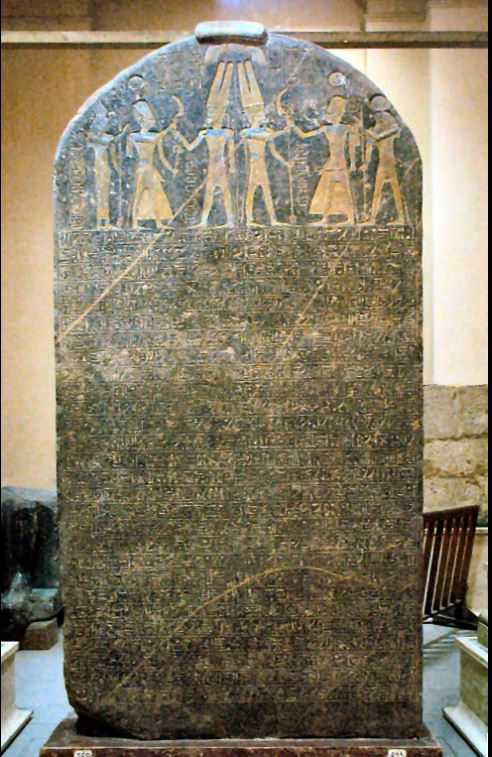
A 13th-century date for the Exodus also finds support in the Merneptah Stela, a monument celebrating Merneptah’s military victories in Canaan. The Merneptah Stela is also known as the “Israel Stela” because it contains the first reference to Israel outside the Bible. Since Merneptah ruled Egypt from 1213-1203 B.C. (these are Hoffmeier’s dates; John Bright’s dates are 1224-1211 B.C), the reference to Israel indicates that during his reign Israel was already in Canaan.

Another evidence presented by Prof. Hoffmeier is the geographical references that appear in the book of Exodus. According to him, the names Pithom (Exodus 1:11), Migdol (Exodus 14:2), and Yam suf (“Sea of Reeds”) “are attested beginning in the 19th Dynasty sources, but are not found prior to the 13th century” (p. 235). In addition, Prof. Hoffmeier also says that toponyms such as Pi-hahiroth and Baal-Zaphon (Exodus 14:2) also begin to appear in 13th century documents.

Prof. Hoffmeier raises an important problem in the discussion of the Exodus. The problem he mentions is the absence of any reference to Egyptian military presence in Canaan in the books of Joshua and Judges. According to him, Merneptah’s presence in Canaan was due to Israel’s expansion in the days of the judges. After Merneptah’s invasion, Egypt’s influence in Canaan began to diminish because of the arrival of the Philistines.

Prof. Hoffmeier believes that a veiled reference to Merneptah may be found in Joshua 15:9 and 18:15. In these two passages the Hebrew words עין מי נפתוח are translated as “The Springs of Waters of Nephtoah.” However, he believes that the words for “spring” and “waters” are redundant and should be translated as “The Spring of Menephtoah,” a name identical to Merneptah.

In his article Prof. Hoffmeier discusses the issue of large and symbolic numbers, dealing primarily with the number 480 and the use of the number 40 in the Bible. He also discusses the problem of the Pharaoh of the Exodus and issues related to the conquest of Canaan.

In his conclusion, Prof. Hoffmeier says that there are biblical and archaeological evidence for a 13th-century for the date of the Exodus. I agree with his conclusions. The biblical evidence points to a 13th-century date for the Exodus and so does the archaeological evidence, as Prof. Hoffmeier has demonstrated. As for the large number in 1 Kings 6:1, it can be interpreted in different ways, as Prof. Hoffmeier also shows in his article.

I also concur with Prof. Hoffmeier's admonition at the end of his article: “I ... urge evangelical biblical scholars, historians, and archaeologists not to expend all their energies on defending a date for the exodus when the real debate today is whether the books of Exodus-Judges contain any history at all and if there was a sojourn and an exodus.”

Prof. Hoffmeier’s article deals with many important issues related to the 13th-century date of the exodus. This is an article worth reading.

Claude Mariottini
Professor of Old Testament
Northern Baptist Seminary

Tags: , ,

Labels: , , ,