
NOTE:
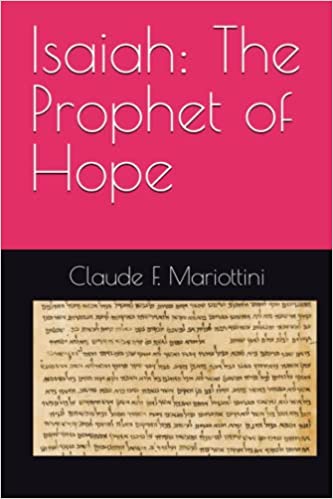
This post has been withdrawn. The post has been published in my book, Isaiah: The Prophet of Hope. The book presents Isaiah’s message of hope, focusing on a study of the Immanuel’s oracle in Isaiah 7:14. You can order the book from Amazon.

Isaiah: The Prophet of Hope
Visit my Amazon author’s page to purchase the book (click here).
Claude Mariottini
Emeritus Professor of Old Testament
Northern Baptist Seminary
A Note About This Post:
Before “Deutero-Isaiah: The Prophet of the Exile” was withdrawn for publication, “Deutero-Isaiah: The Prophet of the Exile” was read by 6101 readers. “Deutero-Isaiah: The Prophet of the Exile” was also shared 41 times by readers who enjoyed reading the post. You can read “Deutero-Isaiah: The Prophet of the Exile” and other articles on Isaiah by reading my book Isaiah: The Prophet of Hope. Below is the content of the book:
CONTENTS
List of Abbreviations – Page vii
Preface – Page ix
Chapter 1 Isaiah, The Prophet of Hope: Isaiah 8:16 – Page 1
Chapter 2 The Donkey and Its Crib: Isaiah 1:3 – Page 9
Chapter 3 The Mountain of the Lord’s House: Isaiah 2:1–5 – Page 13
Chapter 4 The Song of the Vineyard: Isaiah 5:1–7 – Page 16
Chapter 5 The Sign of Immanuel: The Rise of Assyria: Isaiah 7:14 – Page 24
Chapter 6 The Sign of Immanuel: Isaiah 7:4 – Page 29
Chapter 7 The Virgin Shall Conceive: Isaiah 7:14 – Page 34
Chapter 8 The Birth of Immanuel: Isaiah 7:14 – Page 39
Chapter 9 The Presence of Immanuel: Isaiah 8:10 – Page 44
Chapter 10 Immanuel: God Is With Us: Matthew 1:23 – Page 50
Chapter 11 The Child Immanuel: Isaiah 7:10–16 – Page 56
Chapter 12 Isaiah’s Wife: Isaiah 8:3 – Page 59
Chapter 13 The Land That Is in Distress: Isaiah 9:1 – Page 63
Chapter 14 The People Living in Deep Darkness: Isaiah 9:1–2 – Page 68
Chapter 15 “You Have Increased Their Joy”: Isaiah 9:3 – Page 72
Chapter 16 The Peaceful Kingdom: Isaiah 11:1–10 – Page 75
Chapter 17 The Desert Highway: Isaiah 35:1–10 – Page 79
Chapter 18 Deutero-Isaiah: The Prophet of the Exile: Isaiah 40:1–11 – Page 82
Chapter 19 Hope for the Future: Isaiah 40:1–2 – Page 88
Chapter 20 The Way of the Lord: Isaiah 40:3 – Page 95
Chapter 21 God’s Faithfulness and Human Commitment: Isaiah 40:6 – Page 100
Chapter 22 Israel’s Life in Exile: Isaiah 40:27 – Page 104
Chapter 23 Fear and Trust: Isaiah 41:13 – Page 110
Chapter 24 Israel in Babylon: Isaiah 52:4 – Page 113
Chapter 25 The Profanation of God’s Name: Isaiah 52:3–26 – Page 120
Chapter 26 The Punishment of the Wicked: Isaiah 66:24 – Page 127
Bibliography – Page 143
Claude Mariottini
Emeritus Professor of Old Testament
Northern Baptist Seminary
VISIT MY AMAZON AUTHOR’S PAGE
BUY MY BOOKS ON AMAZON (Click here).
NOTE: Did you like this post? Do you think other people would like to read this post? Be sure to share this post on Facebook and share a link on Twitter or Tumblr so that others may enjoy reading it too!
I would love to hear from you! Let me know what you thought of this post by leaving a comment below. Be sure to like my page on Facebook, follow me on Twitter, follow me on Tumblr, Facebook, and subscribe to my blog to receive each post by email.
If you are looking for other series of studies on the Old Testament, visit the Archive section and you will find many studies that deal with a variety of topics.











 Dr. Claude Mariottini - Professor of Old Testament
Reblogged this on Talmidimblogging.
LikeLike
Greetings Dr. Mariottini,
I agree with you that validation of the inspired Word of God is not tethered to what person or persons penned any particular book (as well as your basic premise). However, in the case of Isaiah, I find it difficult to understand the need for there to be another contributor to the book. In fact, I find it less plausible that such extensive writing could be added, without notice or mention of the responsible men charged with guarding and canonizing the scriptures, especially to such a profound book as Isaiah. In my view, what you and others suggest, would be akin to someone doubling the size and scope of the Gettysburg Address in the year 2016. And again, I don’t understand the need.
Isaiah had a long ministry. Ten years after he began, the northern 10 tribes were taken into captivity by the Assyrians. Deportation continued for the next two decades. It was more than 100 years later that the house of Judah went into captivity to Nebuchadnezzar. Then almost a century till Cyrus enters the picture. You seem to make no distinction between “the house of Israel” and “the house of Judah”.
I see a similar problem with your Ezekiel 37:11 reference, in that you use this verse in regard to Judah, when it clearly says in the verse itself, that this is to the “whole house of Israel”. That would certainly include the northern 10 tribes. All of this is even more clear as one reads the rest of chapter 37 of Ezekiel. When viewed this way, it is clear that Ezekiel is writing of the millennial period when “all Israel will be saved” (Romans 11:26).
But to be clear, my question does not rest on what I agree would be “weak and insufficient grounds”, i.e., the title of the book. What is the need for “Deutero-Isaiah”? Does the writing in Isaiah somehow not fit with the idea of him being the sole author?
With respect,
Dick Hall
LikeLike
Dick,
Thank you for your comment. The problem with your premises is the way you understand the formation of the canon of the Old Testament. Take for example the book of Psalms.
There are five different books within the book of Psalms. There are psalms by Moses, David, Solomon, Asaph, the sons of Korah, Heman, and Ethan. Psalm 137 was written in Babylon. So, if you take Moses (1260 B.C.) and Psalm 137 (560 B.C.?), then it took 700 years for the book to be completed. David did not write the book of Psalm. The final composition of the book of Psalm is the work of an anonymous editor who lived in Babylon.
To say that Ezekiel 37 refers to the millennial is to take the book completely out of its historical context. When you do so, the book of Ezekiel has no message to the people who lived in exile. Do a thorough study of Isaiah 40-66 and you will find many references to the destruction of Jerusalem, of the temple, and mention of the people in exile. I believe what the text says.
Claude Mariottini
LikeLike
Great piece i dare say.
I named my son Cyrus due to the messianic prophecies of Isaiah 45 especially verse 1 of that chapter . Are you saying ,sir, that Isaiah chapter 45 was written during the life time of that great emperor?
LikeLike
Niyi,
Cyrus was a great emperor and your son is fortunate to have such a great name.
Isaiah 40-55 was written by a prophet who live in Babylon during the times of Cyrus. If you read what Deutero-Isaiah has to say about Cyrus and what Cyrus says about himself in the Cyrus Cylinder, you will think that Deutero-Isaiah was an eye witness of the events related to Cyrus.
Thank you for visiting my blog.
Claude Mariottini
LikeLike
great piece. my favourite OT prophet and i spent 9 years part-time study to do a phd on the fear not oracles in isaiah 40-55.
will reblog this post into my blog. tq
LikeLike
Dear Professor Loke,
Thank you for your nice words about my post. I sure would wile to read your dissertation. Has it been published?
Claude Mariottini
LikeLike
Thank you ,I am currently studying a book written on Prophet Isaiah.I checked on the net atleast to get more light of the book and i have come across your writing .Indeed there seems to be a descripancy first in you analysis of the historical esxiles of the Northern as well as the Southern Tribes .There is also a dearing plunge into faslehood in supposing that ,the Lord wouldnt be so omnscient as to give Isaiah a look into the future even to the new heavens and the new earth at the very end of the book.I would ask who wrote the rest of the chapters from 55-66 of the book of Isaiah.
LikeLike
Leonard,
Thank you for your comment. The view you are mentioning is the traditional way of interpreting the book of Isaiah. However, a historical and linguistic study of the book clearly shows that the background of Isaiah 40-55 is Babylon, not Judah. The issue is not God’s inability to show the future to Isaiah. The issue is that the biblical text, as written, clearly shows that Jerusalem was already destroyed and that the people were about to return to Jerusalem. Isaiah 40-55 was written by one of Isaiah’s disciples who was taken into exile. He was inspired to write the book as all other writers of the Old Testament were inspired by God.
Claude Mariottini
LikeLike
i agree with your article, but how do you explain the New Testament authors assigning their quotes of the later chapters of Isaiah, to the prophet Isaiah? Even Jesus says he is quoting Isaiah 2ce. For example, in Matthew 8:16–17 Jesus is quoting Isaiah 53:4
LikeLike
Wayne,
The New Testament was written more than 500 years after the book of Isaiah was written. By that time, the book had a long tradition and it was consider to be one book. The same thing happens with the book of Samuel. Samuel died in 1 Samuel 25:1 but the book is still attributed to him. There is even a 2 Samuel.
Thank you for your comment.
Claude Mariottini
LikeLike
I would note a few things Wayne:
1. If the second and third sections of Isaiah were written by disciples of a community founded by Isaiah—and this seems likely to me—then those disciples would still understand their own voice as that ‘of Isaiah’.
2. The recognition that 40 represents a very new and different voice directed to a very different context is not part of modern scholarship, but dates back to a medical Jewish rabbi from here in Spain, where I live. So the observation is not part of modernity at all.
Blessings.
Duane Alexander Miller, PhD
Assoc. Prof. of Old Testament
Protestant Faculty of Theology at Madrid
LikeLike
Duane,
Thank you for your clarification.
Claude Mariottini
LikeLike
i agree with you, but i think the reason Jesus and his disciples said they were quoting Isaiah in their many quotes, is that regardless of whether Isaiah said everything in the book bearing his name, they were on a life or death mission, and would not enter into a discussion of who the particular author of every chapter was. Saying they were quoting Isaiah was the same as saying they were quoting the book, the source of the quote, which bears Isaiah’s name. Besides which, we dont know the name of the other 2 authors; neither did the disciples; and Jesus certainly was not on a mission to argue who was the author. Can you imagine Jesus saying “as Habakkuk said….” and the quote not being found in the book of Habakkuk?”
LikeLike
Wayne,
By the first century, the traditional authorship of the books of the Old Testament was accepted by many. Jesus and his disciple did not do a literary analysis of each book of the Old Testament. That was not their concern. As you said, “they were on a life or death mission.” That was their concern.
Claude Mariottini
LikeLike
Claude, I agree with your scriptural exegisis and comments of everything i’ve read so far. very unusual. That being the case, i would like to discuss Gen. 6:2 with you. (I have written 2 books on OT History and have a short chapter on this topic.)
LikeLike
I will be glad to dialogue with you. SEnd me an email to:
drcfmariottini@gmail.com
Claude Mariottini
LikeLike
Claude, I agree with your scriptural exegisis and comments. thankyou for replying. I would also like to discuss Gen.6:2 with you, if you have time. wayne
LikeLike
Wayne,
Read the email I sent you.
Claude Mariottini
LikeLike
dear Claude,
the purpose of my chapter on Gen.6:2 is to inform and make christians aware of the compromise the angel interpretation is to the integrity of the whole of Scripture.(similar to the long ages, gap theories do to Gen.1) This theory no doubt originally came from either the LXX or 1 Enoch. As one site on the internet says,(paraphraze): If God let this happen before, why not again? And it goes on to further it’s theory of Satan coming to earth in the last days as an alien. Adding Greek Mythology to the bible,like the legend of Hercules, which is what the angel interpretation does, undermines the ethics of it’s Author. Blessings. wayne.
LikeLike
Wayne,
Your intent is noble, but it has many flaws.
If you want to continue the dialogue, use the email I sent you.
Claude Mariottini
LikeLike
Pingback: Israel in Babylon (Isaiah 52:4) by Claude F. Mariottini | Crossmap Blogs