Subscribe to Dr. Claude Mariottini - Professor of Old Testament Subscribe in NewsGator Online

Wednesday, February 25, 2009

Hezekiah and the Assyrian Crisis

The events related to the Assyrian invasion of Judah and the siege of Jerusalem are difficult to determine because the timing and sequence of events as they appear in the book of 2 Kings is difficult to interpret. Assyrian records provide supplementary information that helps determine what happened before, during, and after the invasion of Jerusalem. An item of controversy is the sequence of events related to Sennacherib’s campaign in 701 B.C. This post will address some of the political issues related to Hezekiah’s rebellion against Assyria. My next post will deal with Sennacherib’s invasion and the siege of Jerusalem.

When Hezekiah became king of Judah in 715 B.C., Assyria was the dominant power in the Ancient Near East. During his reign, all of Hezekiah’s actions, his political and economic reforms, and his alliances with Egypt were preparation for his revolt against Assyria.

The siege of Samaria began under the Assyrian king Shalmaneser V (726-722). However, he died just before the city was conquered. The conquest of the Northern Kingdom was finished by Sargon II. When Sargon became king in 722, he incorporated Samaria into the Assyrian empire. He deported 27,290 citizens of the Northern Kingdom to Assyria.

Under Ahaz, Judah had become a protectorate of Assyria and paid tribute to their overlord every year. During the reign of Sargon, Judah continued as a satellite state of Assyria and Hezekiah continued paying the yearly tribute.

When Sargon became king, many nations controlled by Assyria revolted against the empire. Sargon’s attention was required somewhere else, leaving Palestine free to recover somewhat politically. Babylon, under Merodach-baladan (2 Kings 20:12, Isaiah 39:1) revolted against Assyria (720 B.C.).

With the help of the Elamites, Babylon broke free from Assyrian control for twelve years. Urartu, the Assyrian enemy to the north, revolted in 719 B.C. Phrygia, a city in Asia Minor, and Carchemish, a Hittite city in North Syria, revolted against Assyria at this time. Sargon invaded Asia Minor and deported most of the population to other parts of the empire. The Medes, a group of people from the Iranian plateau, revolted in 715 B.C.

Because of political instability in his empire, Sargon was unable to embark on any significant campaign into Palestine for several years following the fall of Samaria in 722 B.C. In 716 B.C. Piankhi, an Ethiopian king, became king of Egypt. Piankhi's policy was to unify Egypt and to extend Egypt's control to Asia. With the presence of Egypt in Asia, Assyrian vassals in Palestine turned to Egypt for help against Assyria.

Several of the Philistine cities revolted against Assyria in 714 B.C. in what is commonly known as the Ashdod Rebellion. Ashdod withheld its tribute and other Philistine towns also rebelled. Egypt had political interests in this rebellion. According to Assyrian documents, Judah, Edom, and Moab were invited to participate in the rebellion.

Hezekiah was tempted to join the alliance and may have discussed this possibility with Egypt since Isaiah says that Egypt sent ambassadors in what the prophet sarcastically called “vessels of papyrus” (Isaiah 18:1-2). Both the desire for political freedom from Assyria and the requirement of paying the annual tribute to Assyria were strong motivating factors that almost prompted Hezekiah to join this rebellion.

The prophet Isaiah strongly opposed the revolt against Assyria (see Isaiah 20:1-4). According to the text, Isaiah walked around naked and barefoot to demonstrate what would happen to Egypt and Ethiopia and the foolishness of trusting in them for help. Although the text is silent on Hezekiah’s decision, it is clear that he listened to Isaiah’s words and did not participate in the revolt for when Sargon crushed the revolt, Judah did not suffer any reprisal from Assyria.

After Sargon’s decisive demonstration of force, Hezekiah made no other overt act of rebellion against Assyria. As long as Sargon ruled, Judah remained a vassal and paid the annual tribute to Assyria. However, while Hezekiah continued paying the annual tribute, he quietly began his preparations for revolt.

These preparations for a possible revolt included a concerted effort to arm Judah, to prepare for war, and to plan against a siege of Jerusalem. As discussed in a previous post, Hezekiah prepared for his revolt against Assyria by making weapons and setting combat commanders over the people, by preparing storehouses for the harvest, stalls for the animals, by rebuilding the broken walls of Jerusalem, by strengthening the Millo, and by making a water tunnel to bring water into Jerusalem.

In 705 the opportunity for rebellion against Assyria became a possibility. Sargon was killed in a battle and his death motivated several of the vassal nations to revolt against Assyrian domination. When Sennacherib, Sargon’s son, ascended the throne, he immediately took steps to deal with vassal rebellion against his kingdom. Merodach-baladan had revolted against Assyria and regained his throne in Babylon. With Elamite help, Merodach-baladan fought against Assyria until 702 when Sennacherib was able to subdue Babylon. At the same time Sennacherib was fighting against Babylon, rebellion broke out in the west and it was into this situation that Judah was eventually drawn.

It was in the midst of this political upheaval that Merodach-baladan sent messengers to Hezekiah to congratulate him for recovering from his illness (2 Kings 20: 12-19; Isaiah 39:1-8). It is possible that the real purpose of the Babylonian embassy was to gain Judah’s assistance in the Babylonian struggle against the Assyrian stronghold.

Scholars are not in agreement with the purpose of the Babylonian visit. However, since Merodach-baladan was fighting against Sennacherib and Assyrian imperialism, it is possible that he wanted to enlist potential allies or at the very least promote diversionary rebellions to occupy Sennacherib’s attention which would then relieve Assyrian pressure from the Babylonian army.

According to the Deuteronomic historian, sometime after Sargon’s death in 705 B. C., Hezekiah withheld his tribute from Assyria: “He rebelled against the king of Assyria, and would not serve him” (2 Kings 18:7). This act of defiance was an open declaration of rebellion against Assyria.

Hezekiah took action against some of the Philistine cities that refused to join in the revolt (2 Kings 18:8). According to Sennacherib’s inscription, the people of Ekron deposed their king, who was loyal to the Assyrians, and delivered him to Hezekiah who kept him captive in Jerusalem.

Hezekiah sent an embassy to Egypt asking for help. Isaiah opposed this alliance with Egypt and called it “a covenant with death” (Isaiah 28:15). He warned against the revolt by declaring that an alliance with Egypt would bring disaster to Judah:

“Oh, rebellious children, says the LORD, who carry out a plan, but not mine; who make an alliance, but against my will, adding sin to sin; who set out to go down to Egypt without asking for my counsel, to take refuge in the protection of Pharaoh, and to seek shelter in the shadow of Egypt; Therefore the protection of Pharaoh shall become your shame, and the shelter in the shadow of Egypt your humiliation” (Isaiah 30:1-3 NRSV).

While Isaiah was successful in stopping Hezekiah from revolting against Sargon during the Ashdod Rebellion in 714 B.C., he was unsuccessful in stopping Hezekiah from revolting against Sennacherib. Scholars have suggested that Hezekiah’s revolt against Assyria came as a result of his illness. Since Hezekiah became very sick and was at the point of death (2 Kings 20:1), it is possible that he became too incapacitated to handle the duties of the kingdom and that his princes and nobles took the initiative to enter into this alliance with Egypt.

It is also possible that the anti-Assyrian faction in his government pressured him to revolt against Assyria and that he was the one who decided to establish the alliance with Egypt. Regardless of the motivation behind the alliance with Egypt, the decision to revolt had been made and there was nothing else to do but to prepare for the coming of Sennacherib and the siege of Jerusalem.

Other posts on Hezekiah:

1. Hezekiah , King of Judah

2. Hezekiah’s Religious Reforms

3. Hezekiah’s Political and Economic Reforms


Claude Mariottini
Professor of Old Testament
Northern Baptist Seminary

Tags: , ,

Bookmark and Share

Labels: , ,

Monday, February 09, 2009

Hezekiah’s Political and Economic Reforms

At the same time Hezekiah was reforming the religious life of Judah, encouraging the people to worship and serve Yahweh only, he was also embarking on a program to reorganize the government and improve the economic conditions of Judah. Many of these reforms were likely done in preparation for his revolt against Assyrian domination. However, Hezekiah’s economic reforms were a genuine effort at improving the socio-economic conditions of the people of Judah.

Some of Hezekiah’s political reforms were part of his effort to arm Judah, to prepare for war, and to plan for an eventual siege of Jerusalem. According to the Chronicler, Hezekiah repaired the broken walls of Jerusalem, built defensive towers on the walls, and reinforced the Millo, the defensive rampart of Jerusalem.

Hezekiah also built a second wall of defense around the city which extended the city boundaries. This second wall may have been a defensive measure to enclose the city’s water supply within the walls of Jerusalem. However, archaeological evidence indicates that there was a sizable increase in Jerusalem’s population during the time of Hezekiah, possibly due to the migration of people from the Northern Kingdom to Jerusalem before, during, and after the fall of Samaria in 722 B.C. This increase in population may have been a motivating factor in extending the wall around the city.

Hezekiah made many weapons and shields to supply the army with the armament needed for the war (2 Chronicles 32:5). He set military commanders over the people. Sennacherib’s account of his campaigns against Hezekiah indicates that Hezekiah had both regular and irregular troops under his command. This information indicates that Hezekiah’s army was composed of both the national militia and of foreign mercenaries. According to the Chronicler, Hezekiah gathered his officers and the people together at the public square in front of the city gate and encouraged the people with these words:

“Be strong and of good courage. Do not be afraid or dismayed before the king of Assyria and all the horde that is with him; for there is one greater with us than with him. With him is an arm of flesh; but with us is the LORD our God, to help us and to fight our battles” (2 Chronicles 32:7-8).

Hezekiah’s economic reforms and great wealth are seen by the Chronicler as evidence of God’s blessings (2 Chronicles 32:29). Hezekiah prepared for a possible siege by building storehouses to hold surpluses of wine and oil. He also built stalls for his livestock. This description of Hezekiah’s wealth may reflect his achievements as a king honored by God but may have also another purpose. These economic reforms and building projects were probably designed to provide stockpiles of food for distribution in a time of shortage, such as during a siege.

One of Hezekiah’s greatest engineering achievements was also a step he took to prepare Jerusalem for a possible siege. Jerusalem’s main water source was the Gihon spring, a perennial fountain located outside the walls of the city. During a time of siege, the city’s water supply could be cut off by the besieging army, thus depriving the inhabitants of the city and the city defenders of drinking water. This problem is apparent in the reference to the aqueduct of the upper pool mentioned in Isaiah 7:3, which indicates that Ahaz was taking steps to protect the city’s water supply in preparation for a possible siege of Jerusalem during the Syro-Ephraimite war.

Hezekiah’s aim was to bring water from the Gihon spring and at the same time conceal the source of water from his enemies. In order to build a tunnel and bring water into the city (cf. 2 Kings 20:20), Hezekiah’s engineers cut an aqueduct that is more than 1700 feet long (about 500 meters long), underneath the walls of Jerusalem, through solid rock, in order to bring water from the Gihon spring into the Pool of Siloam. The Gihon Spring was concealed and the cave was sealed up in order to protect the source of water. An inscription written in ancient Hebrew script and found on the wall of the tunnel in 1880 confirms the Biblical account of this engineering achievement and describes how the two teams of hewers working from opposite directions literally met in the middle.

The passage reads (ANET p. 321):

[...when] (the tunnel) was driven through. And this was the way in which it was cut through:- While [ . . . ] (were) stil [ . . . ] axe(s), each man toward his fellow, and while there were still three cubits to be cut through, [there was heard] the voice of a man calling to his fellow, for there was an overlap in the rock on the right [and on the left]. And when the tunnel was driven through, the quarrymen hewed (the rock), each man toward his fellow, axe against axe; and the water flowed from the spring toward the reservoir for 1,200 cubits, and the height of the rock above the head(s) of the quarrymen was 100 cubits.

In addition to military improvements in preparation for a conflict with Assyria, Hezekiah also implemented other reforms which were designed to improve Judah’s economy and promote a more efficient government.

One of these changes was his attempt to introduce a system of tax collection and the development of a royal storage system for collecting tax in kind. Excavations at several sites in Judah have uncovered large storage jars containing a special type of seal impression on them. Hundreds of these seal impressions have been unearthed almost exclusively in Judean sites. The most popular of these seal impressions are those that contain the Hebrew inscription lmlk, a word which means “belonging to the king.” The seal impressions also include the name of four places: Hebron, Socoh, Ziph and mmsht, a name that remains unidentified.

According to J. Maxwell Miller and John H. Hayes, A History of Ancient Israel and Judah, 2nd ed. (Louisville: Westminster John Knox Press, 2006), p. 413,

“The use of these impressions was introduced under Hezekiah and is evidence for the administrative system used during his reign. The jars were part of a system of tax collection in kind or a royal storage program. The material collected in these containers was sent to four district centers for storage, redistribution, and administrative/military usage. These centers were Socoh for the Shephelah region, Ziph for the Negeb, Hebron for the southern hill country and mmsht for Jerusalem and the northern Judean hill country.”

There is some debate concerning the dating of lmlk seals. However, most archaeologists believe that they come from the time of Hezekiah and are related to his economic reforms. The lmlk seals indicate that Hezekiah developed an organized administrative system for the distribution and storage of supplies for use in times of peace and war.

According to John Bright, A History of Israel, 4th. ed. (Louisville: Westminster John Knox Press, 2000), p. 284, it is possible that the lmlk seals reflect an attempt at standardizing weights and measures in order to discourage dishonesty in trade. Bright also suggests that Hezekiah may have developed a system of guilds to protect the craftsmen from exploitation.

Hezekiah’s political and economic reforms indicate that there was genuine evidence of prosperity in Judah at the close of the eighth century B.C. Evidence of this prosperity, at least from Hezekiah’s perspective, may be seen in the Biblical account of the Babylonian envoys’ visit to Hezekiah (2 Kings 20:12-19). Merodach-Baladan, King of Babylon, sent envoys to Hezekiah at the time of his illness, probably as part of the Babylonian’s plan to revolt against Assyria. Hezekiah welcomed the Babylonian envoys and “showed them all his treasure house, the silver, the gold, the spices, the precious oil, his armory, all that was found in his storehouses” (2 Kings 20:13).

Hezekiah’s religious and economic reforms and his military preparations occurred prior to the invasion of Sennacherib in 701 B.C. The accumulation of weapons, the reorganization of the military personnel as well as the building of walls, fortifications, and the water tunnel would have taken time and appear to have been done in preparation for a revolt in his attempt at independence from Assyrian control.


Other posts on Hezekiah:

1. Hezekiah , King of Judah

2. Hezekiah’s Religious Reforms


Claude Mariottini
Professor of Old Testament
Northern Baptist Seminary

Tags: ,, ,

Bookmark and Share

Labels: , , ,

Wednesday, February 04, 2009

Hezekiah’s Religious Reforms

Hezekiah’s religious reforms are described in detail in 2 Chronicles 29-31. At the time Hezekiah began his reforms, both the political and religious climate in Judah were favorable to a return to Yahweh. The prophets Amos and Hosea had been preaching reform in the Northern Kingdom before its demise in 722 B.C., while Isaiah and Micah had been preaching a similar message in the Southern Kingdom, warning the leadership of Judah that they could not survive if they continued oppressing the people and promoting the religious practices that were offensive to the religion of Yahweh.

With the fall of Samaria a few years before Hezekiah became king of Judah, the call to reform was taken more seriously in Judah. It was for this reason that the political and religious actions taken by Hezekiah were enthusiastically supported by many reform-minded people in Jerusalem.

Hezekiah’s reforms came at a crucial time in Judah’s history. The fall of Samaria provided the tangible evidence that the oracles of doom proclaimed by the prophets against Israel for over a century were indeed warnings from Yahweh. Israel had been severely judged. Now, Judah had to reform or face the same fate as the Northern Kingdom.

According to the elders of Judah who lived in the days of Jeremiah, Micah’s prophecy made a profound impact on Hezekiah, leading him to initiate his religious reforms. Micah proclaimed the destruction of the temple and the devastation of Jerusalem:

“Hear this, you heads of the house of Jacob and rulers of the house of Israel, who abhor justice and pervert all equity, who build Zion with blood and Jerusalem with wrong. Its heads give judgment for a bribe, its priests teach for hire, its prophets divine for money; yet they lean upon the LORD and say, ‘Is not the LORD in the midst of us? No evil shall come upon us.’ Therefore because of you Zion shall be plowed as a field; Jerusalem shall become a heap of ruins, and the mountain of the house a wooded height” (Micah 3:9 -12).

According to the elders of Judah, Hezekiah feared the Lord and entreated his favor. Because of Hezekiah’s repentance, the Lord relented of the evil which he had pronounced against the city and against the people (Jeremiah 26:19).

According to the Chronicler, the first action Hezekiah took at the beginning of his reform was to open the doors of the house of the Lord and begin repairing the temple. This happened on the first month of the first year of his reign (2 Chronicles 29:3).

As long as Sargon was alive, Hezekiah could not openly revolt against Assyria. He could not renounce the Assyrian gods immediately after his accession to the throne because this would be considered an act of open rebellion against Assyrian control. Hezekiah began his reform by purifying Judah’s religious practices. Hezekiah was able to take these steps toward independence because, according to Assyrian records, Sargon was preoccupied with rebellions in the northern part of his empire. For this reason, Sargon was not able to make another campaign in Palestine until 712 B.C.

It is possible that Hezekiah began his religious reforms in the first year of his reign as the Chronicler suggests. Hezekiah began his reforms with minor changes in the Temple. Thus, as long as Hezekiah paid his annual tribute to Assyria, Sargon would not see the need to investigate closely the religious activities or other religious events taking place in Judah. It is impossible to know whether Hezekiah removed the Assyrian gods at the beginning of the reform, however, the repair, cleansing, and purification of the temple were the initial steps taken at the beginning of the reform.

It seems that the reforms of Hezekiah began with the centralization of the worship in Jerusalem. The words of the Assyrian ambassador imply that Hezekiah made an attempt at closing the places of worship outside Jerusalem. The Assyrian ambassador accused Hezekiah of eliminating the high places and the foreign altars and forcing the people of Judah and Jerusalem to worship only at the altar of God in Jerusalem (2 Kings 18:22).

The act of purging the cult of pagan altars and high places and the centralization of the worship of Yahweh in Jerusalem carried both religious and political overtones. By making the people worship in Jerusalem, the priests in the temple would be able to supervise the religious activities of the people and eliminate the syncretistic practices that took place in the local shrines. In addition, the religious pilgrimages to Jerusalem also would promote the people’s allegiance to the Davidic covenant and to the Davidic king. Hezekiah sought to revive the old Davidic rule by seeking to bring the Northern tribes under the control of the king in Jerusalem (2 Chronicles 30:1-12).

It is possible that the repairs of the temple included overlaying the doors and doorposts with gold. According to 2 Kings18:16, during the siege of Jerusalem in 701 B.C., Hezekiah stripped the gold from the doors of the temple of the Lord and from the doorposts in order to pay his tribute to Sennacherib, king of Assyria.

Hezekiah’s reforms included the destruction of the local pagan shrines as well as the images that were in these shrines. According to 2 Kings 18:4, Hezekiah “removed the high places, broke down the pillars, and cut down the sacred pole. He also broke in pieces the bronze serpent that Moses had made, for until those days the people of Israel had made offerings to it; it was called Nehushtan.” The destruction of the bronze snake that Moses had made for the Israelites during their sojourn in the desert (Numbers 21:4-9) indicates that by the time of Hezekiah, the bronze serpent had become an object of worship.

At the beginning of his reforms, after the repair and purification of the temple, the people of Judah prepared for the celebration of the Passover. Hezekiah invited those Israelites from the Northern Kingdom who were living in the Assyrian province of Samaria (Samarina) to join the Judeans in the celebration of the Passover. Hezekiah’s effort at bringing the remnant of the Northern Kingdom may have been an attempt at reuniting the two nations and restoring the Davidic dynasty, thus making Jerusalem and the temple the focus of the religious life of a revitalized Israel.

While some people may have come from Galilee, the effort to bring the people from the tribes of the North was unsuccessful. There are several reasons why Hezekiah’s attempt at including the Northern tribes was unsuccessful. First, it is possible that the ancient problem of tribal rivalry and jealousy may have prevented some of the Israelites who lived in the former Northern Kingdom from coming to Jerusalem.

Second, the fear of Assyrian reprisal may have played an important role in preventing the people from the north from coming to Jerusalem. The Assyrians had restored and reorganized the Bethel sanctuary in order to provide a place of worship for the remnant of the Northern tribes.

Third, the people now living in the province of Samaria were Assyrian citizens, thus, a religious pilgrimage to Jerusalem could be construed as an attempt at rebellion against Assyrian control, an act which could bring severe punishment upon the people.

Following the celebration of the Passover in Jerusalem, the people went throughout the cities of Judah and tore down the pillars, the Asherah poles, the altars, and the high places associated with pagan worship.

Hezekiah’s reform also included the reorganization of the work of the priests and the Levites. Hezekiah made a personal contribution for the sacrifices of the burnt offerings, but he asked the people who lived in Jerusalem to bring their tithes and offerings to provide for the needs of the religious personnel in the temple so they could devote themselves to the service of the Lord. The people responded with enthusiasm and gave generously and liberally. The king and religious leaders prepared storage rooms and delegated some of the Levites to collect and distribute the gifts.

Hezekiah was successful in repairing and cleansing the temple and in centralizing the worship of Yahweh in Jerusalem. His reforms included the celebration of the Passover, the destruction of the high places of worship, and the removal of pagan cult objects, but in the long run, his reforms were not permanent. His son Manasseh became a loyal vassal of Assyria and in the process of declaring his fealty to his Assyrian overlord, Manasseh reintroduced several of the pagan practices Hezekiah had eliminated. During the long reign of Manasseh, the people of Judah returned to their idolatrous ways. This situation continued until the days of Josiah, king of Judah, who made another attempt at religious reforms in Judah.

To be continued.

Part 1: Hezekiah , King of Judah

Claude Mariottini
Professor of Old Testament
Northern Baptist Seminary

Tags: ,

Bookmark and Share

Labels: ,

Wednesday, January 28, 2009

Hezekiah , King of Judah

Today I begin a series of studies on Hezekiah, king of Judah. Hezekiah ruled during a turbulent period in the history of the Southern Kingdom. In upcoming posts I will study the kingship of Hezekiah. The posts will deal with the historical situation in Judah at the time Hezekiah assumed the throne. The studies also will deal with his religious reforms, his attempt at political and economic reforms, his attempt at independence from Assyrian control and the crisis that ensued, his illness, and his relationship with the prophets Isaiah and Micah.

The editors of the Deuteronomic history, the biblical section that includes the books of Joshua, Judges, Samuel, and Kings, wrote that Hezekiah, King of Judah, “trusted in the LORD the God of Israel; so that there was none like him among all the kings of Judah after him, nor among those who were before him” (2 Kings 18:5).

In fact, according to the Deuteronomic historians, from the division of the united monarchy in 922 B.C. to the fall of Jerusalem in 587 B.C., there were only four kings in Judah who were considered to be good kings, kings who upheld the religious traditions of the worship of Yahweh. Hezekiah is considered one of these four. No king of the Northern Kingdom was deemed to be a good and faithful king, not even Jehu, a faithful Yahwist.

Hezekiah (715-687 B.C.) became king of Judah at a time marked by religious and political crises. Inheriting the kingdom from his father Ahaz, Hezekiah attempted to overthrow Assyrian control and lead Judah back to freedom and independence. However, in the end, the attempt for independence failed.

Hezekiah’s Accession to the Throne

Hezekiah was the son of Ahaz, King of Judah. His mother’s name was Abi, the daughter of Zechariah. Hezekiah was twenty-five years old when he began his reign and he reigned for twenty-nine years (2 Kings 18:2).

The precise date for Hezekiah’s accession to the throne is debated because of the conflicting information provided in the biblical record. For instance, 2 Kings 18:10 declares that Samaria, the capital of the Northern Kingdom, fell in the sixth year of Hezekiah’s reign: “In the sixth year of Hezekiah, which was the ninth year of Hoshea king of Israel, Samaria was taken.”

Samaria was conquered by Sargon II in 722 B.C. thus, the sixth year of Hezekiah and the beginning of his reign would be 728/7. However, 2 Kings 18:13 indicates that Sennacherib’s invasion of Jerusalem occurred during the fourteenth year of Hezekiah’s reign: “In the fourteenth year of King Hezekiah Sennacherib king of Assyria came up against all the fortified cities of Judah and took them.”

Since Assyrian records indicate that Sennacherib’s invasion took place in 701 B.C., then the accession of Hezekiah to the throne took place in 715 B. C., a date which would place the fall of Samaria during the reign of King Ahaz, Hezekiah’s father. It is possible that Hezekiah ruled as co-regent with Ahaz for fourteen years before becoming king. The reference in 2 Kings 19:9 concerning the confrontation between Sennacherib and Tirhakah, the king of Egypt who ascended the throne in 690, confirms Hezekiah’s 29 years’ reign.

The political situation in the Ancient Near East at the time Hezekiah became king of Judah was very tense because of the presence of Assyria as an imperial power in the region.

Damascus, the capital of the Aramean state, was conquered by Tiglath-pileser III in 732 B.C. According to John Bright, A History of Israel (Philadelphia: The Westminster Press, 1981), p. 275, Tiglath-pileser ravaged the city, killed the leadership of the Aramean state, deported many of the city’s inhabitants to Kir, and the Aramean state was incorporated into the Assyrian empire and it was divided into four Assyrian provinces (see 2 Kings 16:9). The Northern Kingdom was also conquered by Assyria and had become an Assyrian province.

Because of the threat posed by Assyria, the population of Judah was divided between those who were pro-Assyria and those who were anti-Assyria. 2 Chronicles 28:7 suggests that an unsuccessful effort was made to assassinate Ahaz, either before or during the Syro-Ephraimite war.

The Syro-Ephraimite War (2 Kings 16:5-20; Isaiah 7:1-17), Judah’s war against Syria and Israel, forced Judah to request military help from Assyria, (2 Chronicles 28:6-8). Judah had to deplete the royal treasury in order to pay Assyria for help (2 Kings 16:8). Because of the policies of Ahaz during the Syro-Ephraimite War, Judah had become a vassal of Assyria and was required to pay an annual tribute which was a great burden on the nation’s economic resources. Thus, as a vassal, Judah was now within the sphere of influence of the Assyrian empire.

As a result of Ahaz’s struggle with the Israelite-Syrian coalition, the Edomites invaded Judean territory and recovered Elath. According to 2 Chronicles 28:17, some Judean captives were taken at the time of the invasion. The loss of the port of Ezion-geber was an additional economic burden on Judah because with the loss of the port, Judah lost an important trade route.

Additionally, the Philistines raided the Shephelah and the Negeb of Judah and conquered several cities, including Beth-shemesh, Aijalon, Gederoth, Soco, Timnah, and Gimzo settled in them (2 Chronicles 28:18).

Another factor that made an impact on Hezekiah’s reign was the religious life of Judah. Since the days of Ahaz, the religious situation of Judah had deteriorated. As a vassal of Assyria, Judah probably was required to pay homage to the Assyrian gods.

Ahaz introduced a copy of the Assyrian altar into the temple of Jerusalem (2 Kings 16:10-20). Ahaz also introduced Assyrian pagan practices (2 Chronicles 28:23). According to the Biblical text, Ahaz practiced many other pagan rituals: child sacrifice (2 Kings 16:3), he worshiped on high places (2 Kings 16:4), and he also practiced solar worship (2 Kings 23:12; 20:8-11). So, when Hezekiah became king of Judah he recognized the need for political and religious reforms in Judah.

To be continued.

Claude Mariottini
Professor of Old Testament
Northern Baptist Seminary

Tags: ,

Bookmark and Share

Labels: ,

Saturday, January 10, 2009

The King and the Gods

Brown University is sponsoring a symposium in Assyriology on Monday, April 27, 2009. The theme of the symposium is “The King and the Gods: The Interplay of Power, Propaganda, Scholarly Learning, and Religion in Ancient Assyria.”

The blog of the Joukowsky Institute has posted the following information about the symposium:

Abstract:

The departments of Egyptology and Ancient Western Asian Studies, Judaic Studies, and Religious Studies will host for one afternoon three internationally known scholars in the study of the history, culture, languages, and religions of Ancient West Asia: Eckart Frahm (Near Eastern Languages and Civilizations, Yale University), Grant Frame (Near Eastern Languages and Civilizations, University of Pennsylvania), and Beate Pongratz-Leisten (Ancient Near Eastern Studies, Princeton University). The papers will examine from the vast corpus of extant Sumerian and Akkadian cuneiform texts selected aspects of Assyria's contribution to the Mesopotamian cultural heritage in the modern manner of interdisciplinary studies, combining history, art, linguistics, and political/religious ideology. Emphasis is placed on the interplay of power, propaganda, scholarly learning, and religion in ancient Assyria. Brown Professors John Steele and Jamie Novotny will provide responses that take into account Assyria's history, culture, literary and scholarly traditions, and cultic and divinatory practices.

Conference:

The conference will take place at Brown University (Providence, RI, USA) on April 27, 2009. It will be held in the single session from 12:00 noon until 5:00 PM and will consist of three scholarly papers (45 min.) and two responses (20 min.); there will be approximately 15 minutes between papers for questions and discussion.

Papers and Abstracts:

Eckart Frahm (Yale University): “The Many Faces of an Assyrian Royal Advisor: Observations on the Scientific, Literary, and Political Texts of Nabû-zuqup-kenu.”

This lecture will investigate the numerous texts written by Nabû-zuqup-kenu one of Assyria's most important scribes during the reigns of Sargon II (722-705 BCE) and Sennacherib (704-681 BCE), when Assyria ruled all of Western Asia. An attempt will be made to outline Nabû-zuqup-kenu's scholarly duties and to link some of the texts he produced to specific political events.

Grant Frame (University of Pennsylvania): “Politics and Divination in the Neo-Assyrian Period.”

Assyrian monarchs of the first millennium BCE used the widespread belief in? omens and divination--in particular the practices of astrology and extispicy--?to help justify and maintain control of their empire. On the one hand, rulers ?allowed their actions to be influenced by omens and divination, although at? times they clearly attempted to control the influence of the diviners in their court. On ?the other hand, Assyrian monarchs also made use of omens and divination to justify their own? actions, particularly when those actions might have be considered controversial.

Beate Pongratz-Leisten (Princeton University): “Sacred Topography of the Empire: Assyrian State Rituals.”

A problem that larger territorial states, such as the Ur III state and large-scale empires such as Assyria had to face, was to integrate local communities into their central organizational system. In addition to political and economic strategies that tied the periphery to the political and religious center of the city of Assur, the Assyrian rulers relied on the creation of state rituals to stabilize their empire and reinforce the acceptance of their power. The cultic performance of these state rituals required the active participation of the Assyrian king in his role as high priest of the god Ashur. In his effort to integrate the vast territories of his empire, the king's ritual performance was not just a reflection of political power but an active shaping of social bonds and spatial relationships. In addition to the creation of their provincial system, the Assyrian kings used cultic ritual as a further means to build cultural unification and turn intercultural space into intracultural space. The history of the ritual thereby reflects the dynamics of the back and forth of the political frontiers that are pushed towards the borders of the cosmos.

For more information visit of the web page of the Joukowsky Institute.

Claude Mariottini
Professor of Old Testament
Northern Baptist Seminary

Tags: ,

Bookmark and Share

Labels: ,

Monday, December 08, 2008

The Assyrian Alphabet


Photo: The Assyrian Alphabet
Credit: Peter BetBasoo

Peter BetBasoo has a short introduction to the Assyrian language:

Assyrians have used two languages throughout their history: ancient Assyrian (Akkadian), and Modern Assyrian (neo-Syriac). Akkadian was written with the cuneiform writing system, on clay tablets, and was in use from the beginning to about 750 B.C.. By 750 B.C., a new way of writing, on parchment, leather, or papyrus, was developed, and the people who brought this method of writing with them, the Arameans, would eventually see their language, Aramaic, supplant Ancient Assyrian because of the technological breakthrough in writing. Aramaic was made the second official language of the Assyrian empire in 752 B.C. Although Assyrians switched to Aramaic, it was not wholesale transplantation. The brand of Aramaic that Assyrians spoke was, and is, heavily infused with Akkadian words, so much so that scholars refer to it as Assyrian Aramaic.

Read more about Assyrian history by visiting Peter’s web page.

Claude Mariottini
Professor of Old Testament
Northern Baptist Seminary

Tags: , , ,

Bookmark and Share

Labels: , , ,

Tuesday, December 19, 2006

Jonah and the Worm

In his book Assyria: The Forgotten Nation in Prophecy, John Booko quotes a poem by Rev. Charles Vander Ploeg titled “Jonah and the Worm.” That poem describes the plight of Jonah and God’s reaction to Jonah’s anger.

Since I have written two posts dealing with Jonah, Nineveh, and the Assyrians (click here and here), I have decided to publish Vander Ploeg’s poem because I like it and because I think it has a great message

JONAH AND THE WORM
by Rev. Charles Vander Ploeg

When Jonah came out of the belly of the whale,
He went straight to Nineveh and did them assail;
With powerful preaching and pending destruction,
So that the entire city was in disruption.

Then upon man and beast the King proclaimed a fast,
Hoping that God’s anger upon them would not last.
When God saw their repentance then He had pity ,
And said He would not destroy that wicked city.

When Jonah left there he went east and there sat down,
Waiting for the Lord to destroy that wicked town.
After forty days had passed and nothing occurred,
Then Jonah was angry and greatly disturbed.

So then for Jonah God prepared a great big gourd,
And in the shade of it he sat and slept and snored.
A big worm that God prepared then came crawling by,
Ate a big whole in the gourd and caused it to die.

Then Jonah was angry with God and wanted to die,
And said, “I have a right to be angry; haven’t I?”
Then God said, “For that gourd that died you had pity,
And you’re angry because I pitied a city.”

T’was a worm God used to teach Jonah a lesson,
T’was only a worm but Jonah lost the blessin’.
T’was a worm that God used brother Jonah to try,
But Jonah was so mad that he wanted to die.

How many Jonahs there are in the land today,
Who go on a big pout when things don’t go their way,
Some get real angry like brother Jonah of old,
And justify themselves when of their fault they’re told.

When they get real angry they never feel condemned.
They never repent and their ways they never mend.
Like brother Jonah of old they feel justified,
And so in their bad temper they often take pride.

It took a whale to stop Jonah’s flight,
And it took a gourd and a worm to set Jonah right.
So I wonder what the good Lord will have to do,
With some folks who get angry every day or two.

Most people, at one time or another, will experience anger in their lives. Anger is a common emotion and no one is exempt from it. But anger is not a sin. The apostle Paul said: “Don't sin by letting anger control you” (Ephesians 4:26 ). Thus, Paul recognizes that even believers will be angry, however, people must not allow their anger to control their actions.

This is what happened to Jonah. Jonah became so angry with God’s compassion that he desired his own death. Jonah’s problem was that he desired to see the destruction of the people who lived in Nineveh, while God desired to show his mercy upon those repentant people.

James said: “Human anger does not produce the righteousness God desires” (James 1:20). Jonah did not show any compassion with the plight of the Ninevites and became angry when they received God’s grace. What Jonah’s anger reveals is something sad: the man who was called and sent by God to proclaim the message of God’s grace shows by his anger that he did not know the God who sent him nor the extent of his grace.

Claude Mariottini
Professor of Old Testament
Northern Baptist Seminary


Tags: , , , ,

Labels: , , , ,

Tuesday, December 12, 2006

“Blessed be . . . Assyria the work of my hands” (Isaiah 19:25).

In response to my post on Jonah and His God, an anonymous reader wrote:

Allow me first to write that I'm glad to read such comments in order to be able to correct many misconceptions and wrong judgements which are passed upon the ancient Assyrians. I should make it a point and case to put not a penny but a dollar aside for every time I see an article repeating that the ancient Assyrians were "ruthless" people but no one mentions the accomplishments and the civilization that the ancient Assyrians left for the world, in addition to being the first people to believe in the message of salvation and spreading it as far as India, Mongolia, Soumatra, Japan, China, Azerbaijan, and so on with their monuments being witnesses to that great effort long before Marco Polo or the Roman Catholic Church set foot in those remote lands, the missionaries of the Holy Church of The East a.k.a. The Holy Apostolic Assyrian Church of The East, held a Cross in one hand and the Bible in the other and went on foot to preach the Gospel with Christian brotherly love and not coercion. The ancient Assyrians used force just like did the Romans, Greeks or Egyptians, even the Jews did. Since their historical lands in what's today known as Iraq amongst other parts of the Middle East were invaded by Persians, Arabs and Mongols the indigenous Assyrians have paid a highest price over the centuries just to preserve their identity, culture, language and history and they continue to suffer. A final point about Jonah who was supposed to be a believer yet he tried run away from God's command in order not to go to Assyria but the Assyrians listened to his message, repented and later on became the first people to believe in the Messiah and Salvation. The Old Testament is full of different stories which are pro and against people but the most important of them all is this verse from the New Testament Luke 11:32 The word which you used in the article as niphal is the Assyrian word napla from the verb napel meaning to fall. It's a well known fact that the Hebrews spoke Assyrian which is referred erroneously to as Aramaic or Syriac and till today 6 of the Old Testament books are still read by the Jews in what is referred to erroneously as "Aramaic" and the alphabet which the Hebrews or Jews today use is called the Assyrian letters even though they write it differently. The Assyrians believed without seeing but those who had the light amongst them never saw it. Till today the Liturgical calendar of the Holy Apostolic Assyrian Church of The East still commemorates that event with a three day fast named the Rogation of the Ninevites and many traditions are attached to that fast.

I quote the comments of anonymous in full because I am sympathetic to the plight of the Assyrians who are alive today. Their culture has survived even though the Assyrians had to endure much persecution. There are, however, a few points in his comments that need to be addressed.

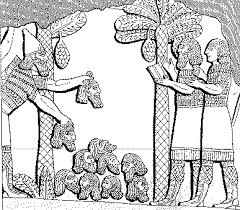
1. The Bible and history show that the Assyrians imposed a policy of terror and violence upon their enemies. The Assyrian monuments give full evidence of their brutality. The graphic above shows Tiglath-pileser III besieging a city and bodies of dead enemies impaled and piled up on the ground.

2. The conversion of the Assyrians is a matter of debate. The book of Nahum gives no indication that the Assyrians were converted. The people who settled in Samaria after the exile of the Northern Kingdom were not Assyrians. They were conquered people deported from their countries and settled in Samaria by the Assyrians (2 Kings 17:2-34). The Assyrians would never repopulate their own people.

3. The original language of the Hebrew people was a dialect of Canaanite; the language spoken by Israel in the pre-exilic time was called “the language of Canaan” (Isaiah 19:18). The language of the ancient Assyrians was Akkadian. When Aramean tribes moved into the region, Aramaic became the dominant language. Aramaic became the official language of the provinces in the Assyrian empire and eventually became an international language, used in diplomacy and trade.

In fact, when the Assyrians invaded Judah, it was very clear that the people did not understand Aramaic. At the time of the invasion, the king of Assyria sent the Tartan, the supreme commander of the Assyrian Army, the Rabsaris, the Assyrian king’s chief officer, and the Rabshakeh, the army’s field commander to King Hezekiah at Jerusalem.

When the Assyrian officers spoke to the officers of Hezekiah, the Israelite officials said to the Assyrian field commander: “Please speak to your servants in Aramaic, since we understand it. Don't speak to us in Hebrew in the hearing of the people on the wall” (2 Kings 18:26).

After the Assyrians established their empire, Aramaic became the language of the Ancient Near East. This is seen when the Bible says that some of the Jews who returned from exile had a difficult time preserving their native language.

The book of Nehemiah says that of the people who came back, “Half of their children spoke the language of Ashdod or the language of one of the other peoples, and did not know how to speak the language of Judah” (Nehemiah 13:24). Thus, when Ezra read the Law of Moses he had to translate it to the people: “Ezra read from the book of the Law of God, translating and giving the sense; so the reading was understood” (Nehemiah 8:8 NJB).

4. Anonymous wrote: “The word which you used in the article as niphal is the Assyrian word napla from the verb napel meaning to fall.”

This is not correct. The word “Niphal” does not come from “naphal” (נפל), a Hebrew word meaning “to fall.” Rather, the word “Niphal” comes from the Hebrew word “pa`al” (פעל) a Hebrew verb meaning “work.” It is also the Modern Hebrew word for “verb.” The word “Niphal” (נפעל) is the word “pa`al” (פעל) with the prefix נ (a preformative) attached to the word “pa`al” to give a passive or reflexive meaning to a verb.

The Bible is not completely negative about the Assyrians. There are several passages in the Old Testament that seem to indicate that Assyria has a special place in God’s plan:

In that day Israel will be the third, along with Egypt and Assyria, a blessing on the earth (Isaiah 19:24).

In this passage, the prophet affirms that in the last days Israel, Egypt, and Assyria will be united as one people under God. Instead of being enemies, they will be united and instead of having different religions, they shall all worship the same God. Israel, together with Assyria and Egypt, will become a blessing to other nations because from them the true religion of God will be extended unto other nations.

Blessed be Egypt my people, and Assyria the work of my hands, and Israel my inheritance (Isaiah 19:25).

In this passage, God calls Assyria “the work of my hands.” This expression is used in parallelism with “my people,” and “my inheritance.” Since Israel is also the work of God’s hand (Isaiah 64:8), the prophet is saying that in God’s hand, Assyria will be a means of blessing to others.

Consider Assyria . . . I made it beautiful (Ezekiel 31:3, 9).

This passage describes in a parabolic manner the greatness that was Assyria. Assyria’s beauty, that it, its power, prosperity, and glory, was the work of God.

From these passages we discover that God has a plan for Assyria. Maybe this is the reason God used them to spread the gospel to other lands.

Many Assyrians today are Christians. According to estimates, there are about 4,000.000 Assyrians in the world today. Of these, 3,000,000 still live in the Middle East; most of them live in Iraq (a country that encompasses the lands of the former Assyrian empire) and Syria and more than 300,000 live in the United States.

If anyone wants to know more about Assyrian Christians, a good source is Assyria: The Forgotten Nation in Prophecy by John Booko. Booko is an Assyrian American and an alumnus of Northern Seminary. Booko’s book takes a maximalist view of Assyria and a pre-millennial view of prophecy.

The book Assyria: The Forgotten Nation in Prophecy can be ordered from:

John Booko,
200 S. Hooker Avenue,
Three Rivers, Michigan 49093
(616) 279-2672


Claude Mariottini
Professor of Old Testament
Northern Baptist Seminary

Tags: , ,

Labels: , ,